01: Is yawning contagious?

A tactile randomization test

Smith College

Jan 28, 2026

Is yawning contagious?

Why would we think so?

Yawning (oscitation) most often occurs in adults immediately before and after sleep, during tedious activities and as a result of its contagious quality.

In humans, yawning is often triggered by the perception that others are yawning (for example, seeing a person yawning, or talking to someone on the phone who is yawning).

This “contagious” yawning has also been observed in chimpanzees, dogs, cats, birds, and reptiles and can occur between members of different species.

MythBusters

MythBusters experiment

  • 50 people randomly assigned to two groups:
    • 34 to a treatment group (person near them yawned)
    • 16 to a control group (no yawn seed)
library(tidyverse)
library(openintro)
yawn |>
  group_by(group, result) |>
  count() |>
  pivot_wider(names_from = result, values_from = n)
# A tibble: 2 × 3
# Groups:   group [2]
  group `not yawn`  yawn
  <fct>      <int> <int>
1 ctrl          12     4
2 trmt          24    10

Basic questions

  • What is the response variable?
  • What is the explanatory variable?
  • What is the risk of yawning, for the treatment group?
  • What is the risk of yawning, for the control group?
  • What is the relative risk of yawning, comparing the treatment to the control?

Big idea

  • We observed that a larger percentage (29% vs. 25%) of those who were seeded with a yawn, actually yawned.
  • But how sure are we that that observed difference (4%) is meaningful?
  • Can we conclude that there is truly an association between these two variables?
  • MB: “It seems like it’s pretty good to me.”
    • Can we be more scientific?

Statistical questions

  • If there were no association between yawning and the proximity of another yawner, what would the relative risk be?
  • \(X\): number of people in the treatment group who yawned
    • What are the possible values for \(X\)?
    • What is a typical value of \(X\)?
    • What is an extreme value of \(X\)?

Statistical inference

  • 10 of 34 people in the treatment group yawned
  • Is that a lot?
  • How do we know?
  • Assume:
    • yawners gonna yawn (those 14 people)
    • no association
    • random assignment to groups

What we’ll do today:

Tactile simulation

Setup

  • Two decks of cards!
  • Make a deck with 36 black cards (non-yawners) and 14 red cards (yawners)
  • Shuffle the cards well
  • Deal out 34 cards (treatment group)
  • Count the number of red cards (yawners)
  • Repeat 5 times, taking turns.
  • When your group is done, add your results to the board

What we actually do:

Computer simulation

Step 1: calculate observed statistic

trmt_yawners <- yawn |>
  filter(group == "trmt", result == "yawn") |>
  nrow()
trmt_yawners
[1] 10

Infer setup

  • Step 2: specify relationship
  • Step 3: make hypothesis
  • Step 4: generate null distribution
library(infer)
null_dist <- yawn |>
  specify(result ~ group, success = "yawn") %>%
  hypothesize(null = "independence") %>% 
  generate(reps = 1000) |>
  summarize(
    trmt_yawners = sum(result == "yawn" & group == "trmt"),
    .groups = "drop"
  )

The null distribution

g <- null_dist |>
  ggplot(aes(x = trmt_yawners)) +
  geom_histogram()
g

Step 5: situate observed in null dist
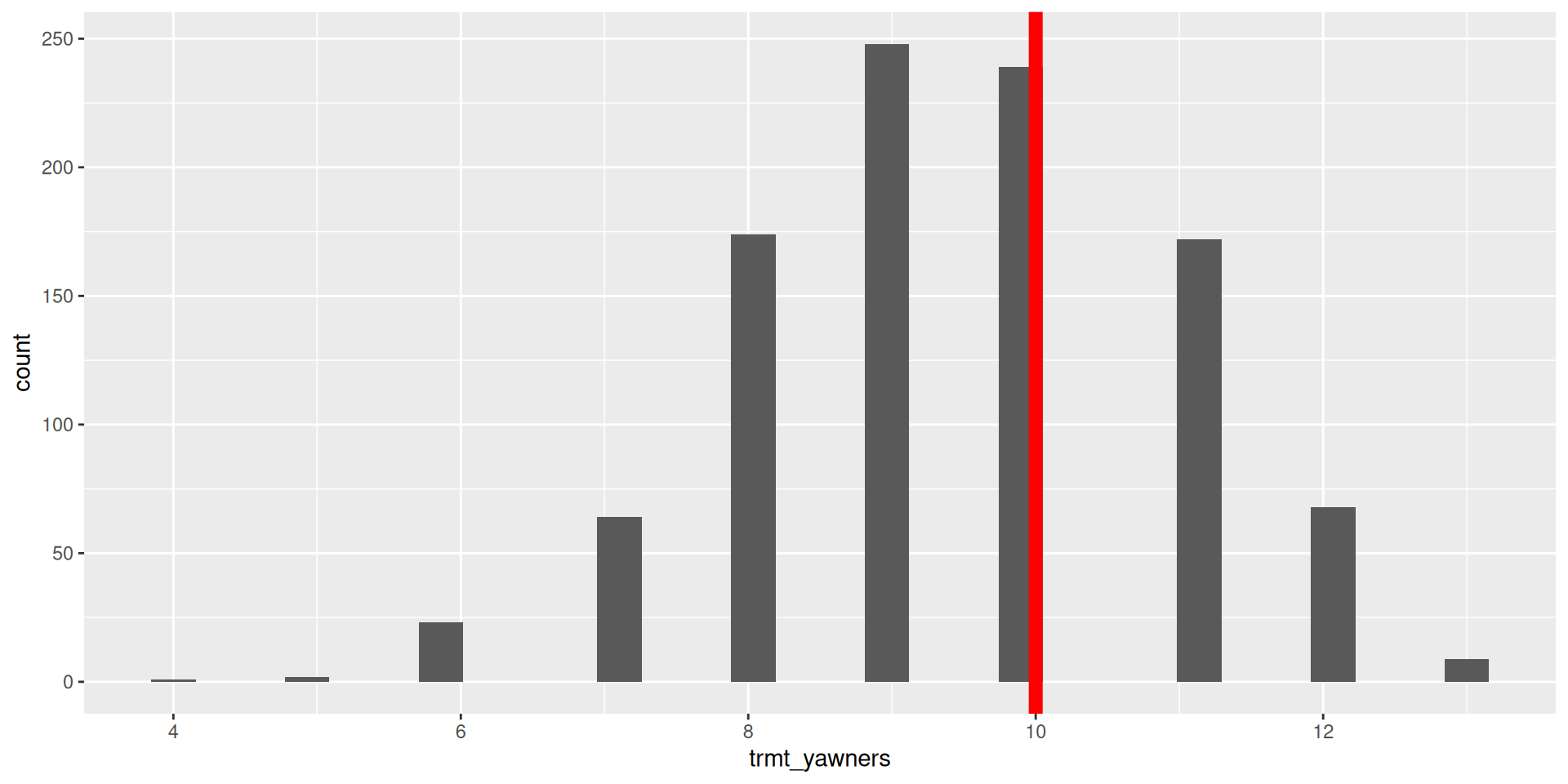
g + 
  geom_vline(xintercept = 10, color = "red", linewidth = 3)
  • Was the observation unusual?

  • Do you doubt the null hypothesis?

So is yawning contagious??

References

Anderson, J. R., & Meno, P. (2003). Psychological influences on yawning in children. Current Psychology Letters. Behaviour, Brain & Cognition, 11, Vol. 2, 2003. https://doi.org/10.4000/cpl.390