07: Linear fit
IMS, Ch. 7
Smith College
Feb 11, 2026
Warmup
Poverty and Unemployment
Research Question
- Is there an association between poverty and unemployment among states? (among all 50 states and the District of Columbia, as of 2020)
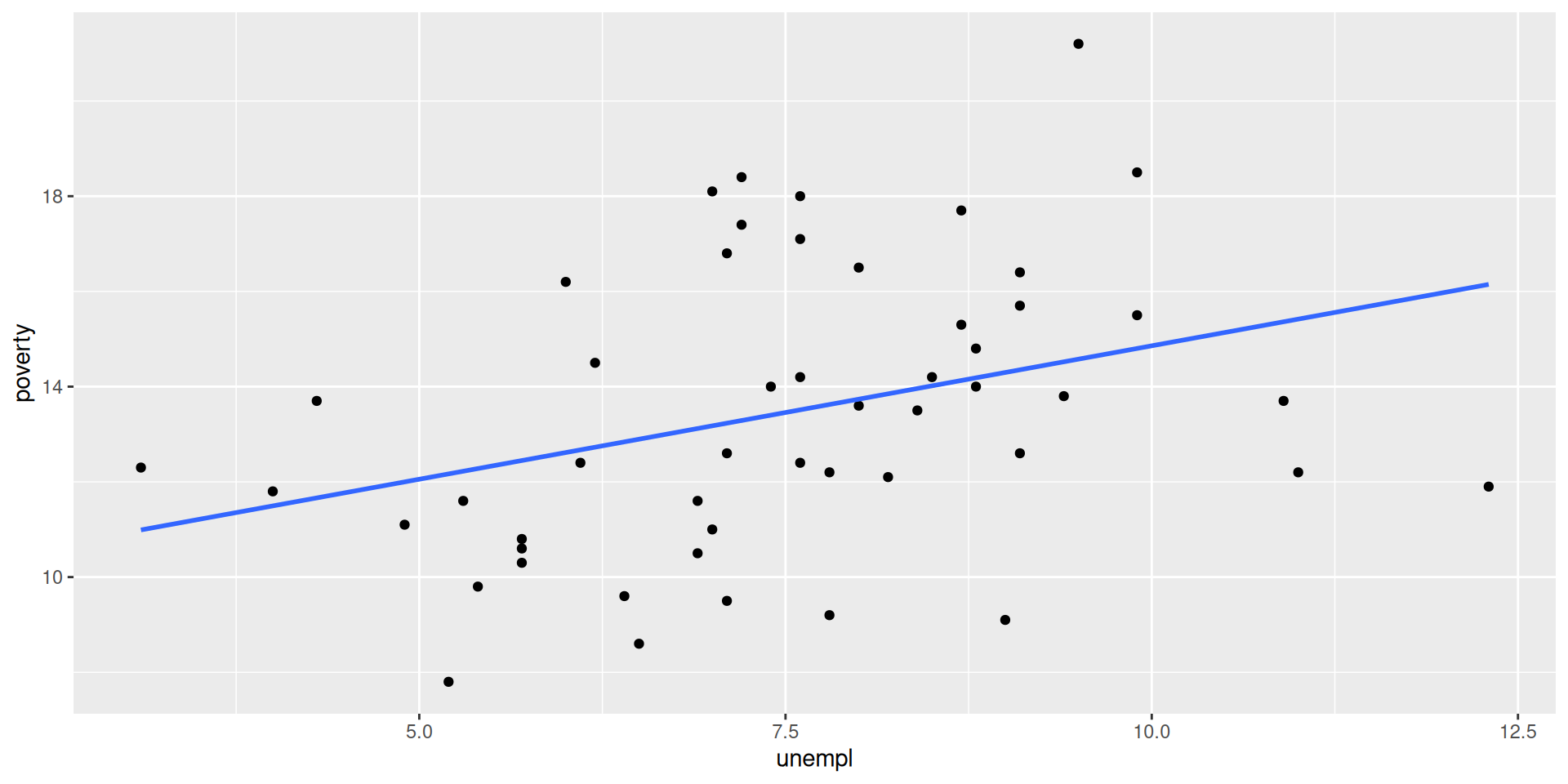
Your turn: SLR by hand!
Problem
- Use summary statistics to calculate the OLS regression line by hand!
# A tibble: 1 × 6
  num_obs mean_poverty sd_poverty mean_unempl sd_unempl correl
    <int>        <dbl>      <dbl>       <dbl>     <dbl>  <dbl>
1 51 13.5 3.02 7.50 1.83 0.340- Recall that \((\bar{x}, \bar{y})\) is always on the OLS line!
Your turn: Interpretations
- Value of slope (\(b_1\)):
- Value of intercept (\(b_0\)):
- Write an interpretation of:
- slope:
- intercept:
A residual
# A tibble: 1 × 4
  state         abbr  poverty unempl
  <fct>         <fct>   <dbl>  <dbl>
1 Massachusetts MA 10.5 6.9- What is the expected poverty rate for Massachusetts (\(\hat{y}_{MA}\))?
- What is the residual for Massachusetts (\(e_{MA}\))?
Measuring the Strength of Fit
\(R^2\)
- percentage of variation in the response variable (\(y\)) that is explained by the explanatory variables.
- coefficient of determination
- \(R^2\) is always between 0 and 1
- For simple linear regression only (one explanatory variable), \(R^2 = r^2\)
- \(R^2 = 1 - SSE/SST = SSM/SST\)
- Recall this picture
\(SST\), in R
- Sum of squares (\(SST\)) has only to do with the response
# A tibble: 1 × 3
      n   SST SST_alt
  <int> <dbl>   <dbl>
1 51 457. 457.- Sum of squares of the null model
- Null model has \(R^2\) of 0 (Why?)
\(SSE\), in R
- \(SSE\) has to do with the model
- Use the
broompackage to work with model objects
\(R^2\), in R
Call:
lm(formula = poverty ~ unempl, data = state_stats)

Residuals:
    Min      1Q  Median      3Q     Max
-5.1974 -1.8006 -0.2719  1.9045  6.6224

Coefficients:
            Estimate Std. Error t value Pr(>|t|)
(Intercept)   9.2528     1.7107   5.409 1.88e-06 ***
unempl        0.5605     0.2216   2.529   0.0147 *
---
Signif. codes:  0 '***' 0.001 '**' 0.01 '*' 0.05 '.' 0.1 ' ' 1

Residual standard error: 2.873 on 49 degrees of freedom
Multiple R-squared:  0.1155,    Adjusted R-squared:  0.09745
F-statistic: 6.398 on 1 and 49 DF,  p-value: 0.01469
RailTrail
- Recall the RailTrail example
- Consider two models (shown here):
- a null model in based strictly on the average volume (left)
- a linear regression model for \(volume\) as a function of \(avgtemp\) (right).
Your turn: RailTrail
- Use
glance()to compute the \(R^2\) value for the second model: - What is the \(R^2\) for the first model?
- Which one fit the data better?
- Write a sentence interpreting the \(R^2\) for the second model
