12: Probability
OI, Ch. 3
Smith College
Feb 25, 2026
Randomness
Randomness
- Key Idea: if a process is random, then individual outcomes can’t be predicted
- BUT: the distribution of outcomes, in the long run, is often quite regular and predictable
- The Law of Large Numbers guarantees that the sample proportion (\(\hat{p}\)) will converge towards the population proportion (\(p\)) as \(n \rightarrow \infty\)
Your turn
Many things in life that are called “random,” are anything but
- Click on the Google spreadsheet link
- Find an empty cell in the first column, and type in a “random” string of 100
T’s andH’s - I’ll use
googlesheets4to crowd-source your work into one long random string
The pledge
If I also generate a random string of T’s and H’s using R’s pseudorandom number generator, do you think I will be able to tell:
- which string was generated by human minds?
- which was generated by the computer?
The turn
Given the length of the string \(n\), it turns out the number of runs of length \(k\), for any integer \(k \geq 1\) is a random variable that follows a known distribution
Probability
Sample spaces
Let \(A, B\) be any two events in a sample space \(S\).
- \(0 \leq \Pr(A) \leq 1\)
- Every event occurs with a probability between 0 and 1.
- \(\Pr(S) = 1\)
- Something in the sample space has to happen
- \(\Pr(A^c) \equiv \Pr (\bar{A}) = 1 - \Pr(A)\)
- probability of \(A\) not happening is 1 minus the probability of \(A\) happening
Disjointness
If \(A\) and \(B\) are disjoint, then they have no outcomes in common, and
\[ \Pr(A \text{ or } B) \equiv \Pr( A \vee B) = \Pr(A) + \Pr(B) \]Note that this is not true if \(A\) and \(B\) are not disjoint
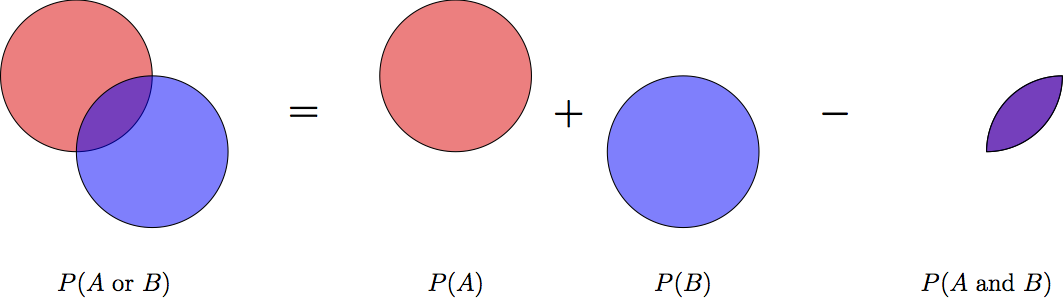
General Addition Rule
- General Addition Rule (or Inclusion-Exclusion Principle): \[ \Pr(A \text{ or } B) \equiv \Pr( A \vee B) = \Pr(A) + \Pr(B) - \Pr(A \wedge B) \]
Independence
- If \(A\) and \(B\) are independent, then \[ \Pr(A \text{ and } B) \equiv \Pr(A \wedge B) \equiv \Pr(AB) = \Pr(A) \cdot \Pr(B) \]
- Note that independence and disjointness are the not the same
- In fact, disjointness precludes independence (since you cannot have both!)
Consider the roll of a fair die
- The sample space is \(S = \{1,2,3,4,5,6\}\)
- \(E = \{2,4,6\}\), the event that the outcome is even
- \(W = \{2, 3, 5\}\), the event that the outcome is prime
- \(\Pr(E) = 1/2\)
- \(\Pr(W) = 1/2\)
- \(\Pr(E \cup W) = 1/2 + 1/2 - 1/6 = 5/6\)
- \(\Pr(E \cap W) = 1/6\)
