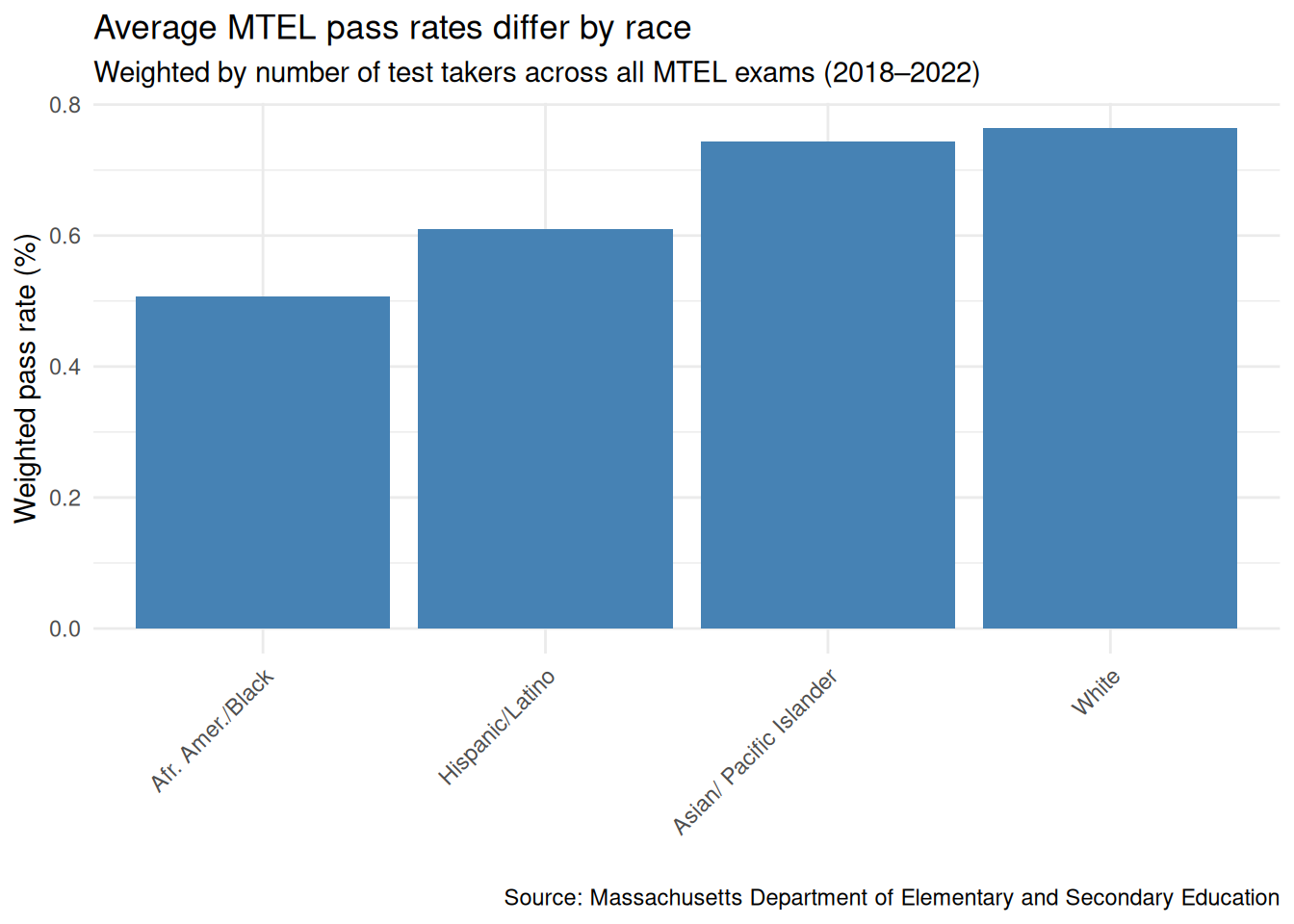
Before stepping into the classroom, educators in Massachusetts are required to pass a series of standardized exams. But not all aspiring educators pass their licensing exams at the same rates – and pass rates fall harshly along racial lines, according to data from the Massachusetts Department of Elementary and Secondary Education.
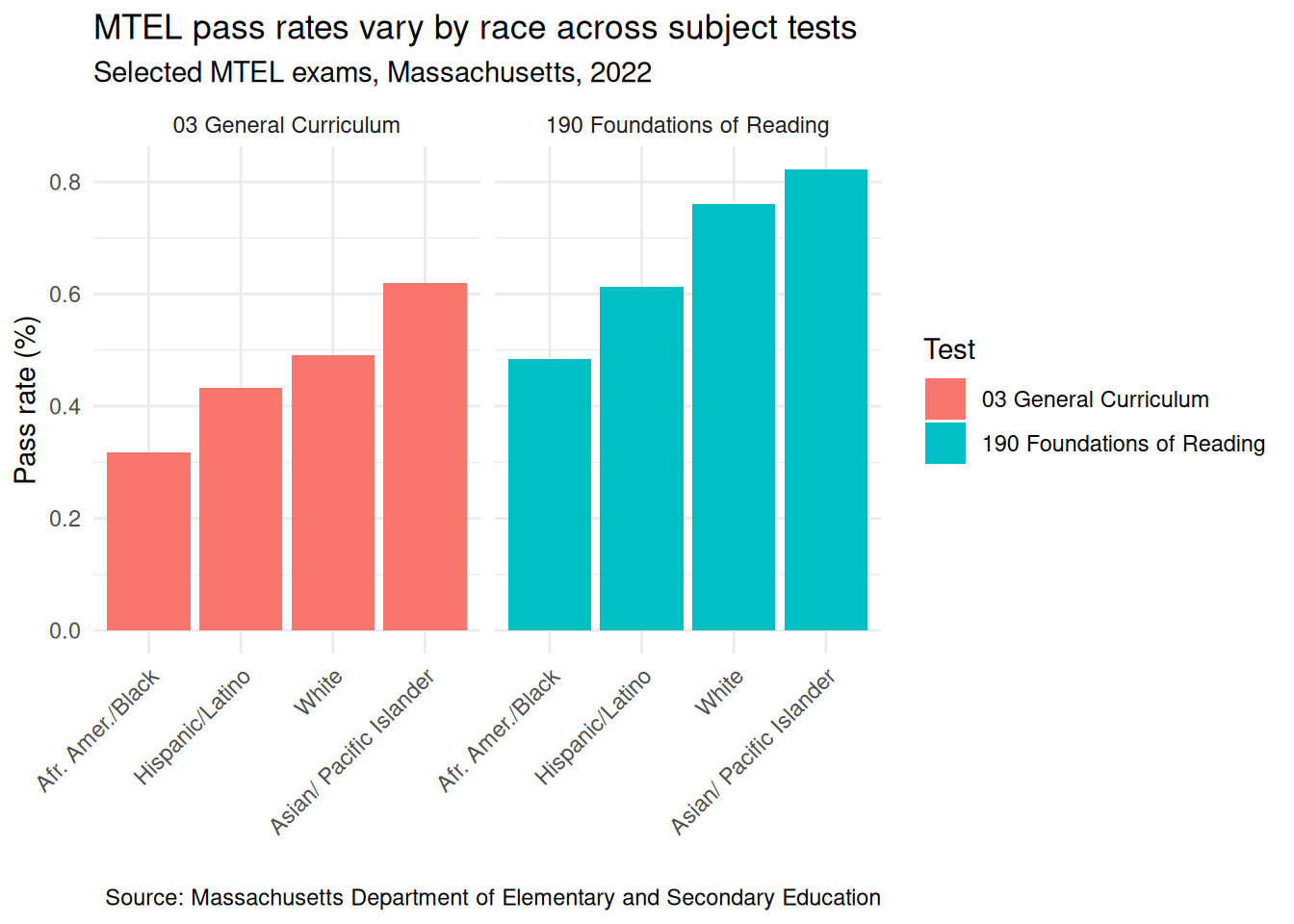
Looking at the Massachusetts Department of Elementary and Secondary Education data reveals some persistent disparities among several MTEL exams. Black and Hispanic test takers pass at significantly lower rates than their white counterparts. These gaps appear in the elementary licensure exams and remain consistent when averaged across other MTEL exams.
These disparities matter in part because Massachusetts classrooms and the teacher workforce do not reflect the state’s student population.
Massachusetts classrooms are getting more diverse, but teachers are not. In the analysis done on data from 2018 to 2022, teachers are consistently more than 90% white, while Massachusetts students are 60% white, or less, and steadily decreasing.
Meanwhile, Hispanic students are increasing in population, while the percentage of Hispanic teachers stays roughly stagnant. The same is true for Black and Asian students and teachers respectively, though less pronounced.
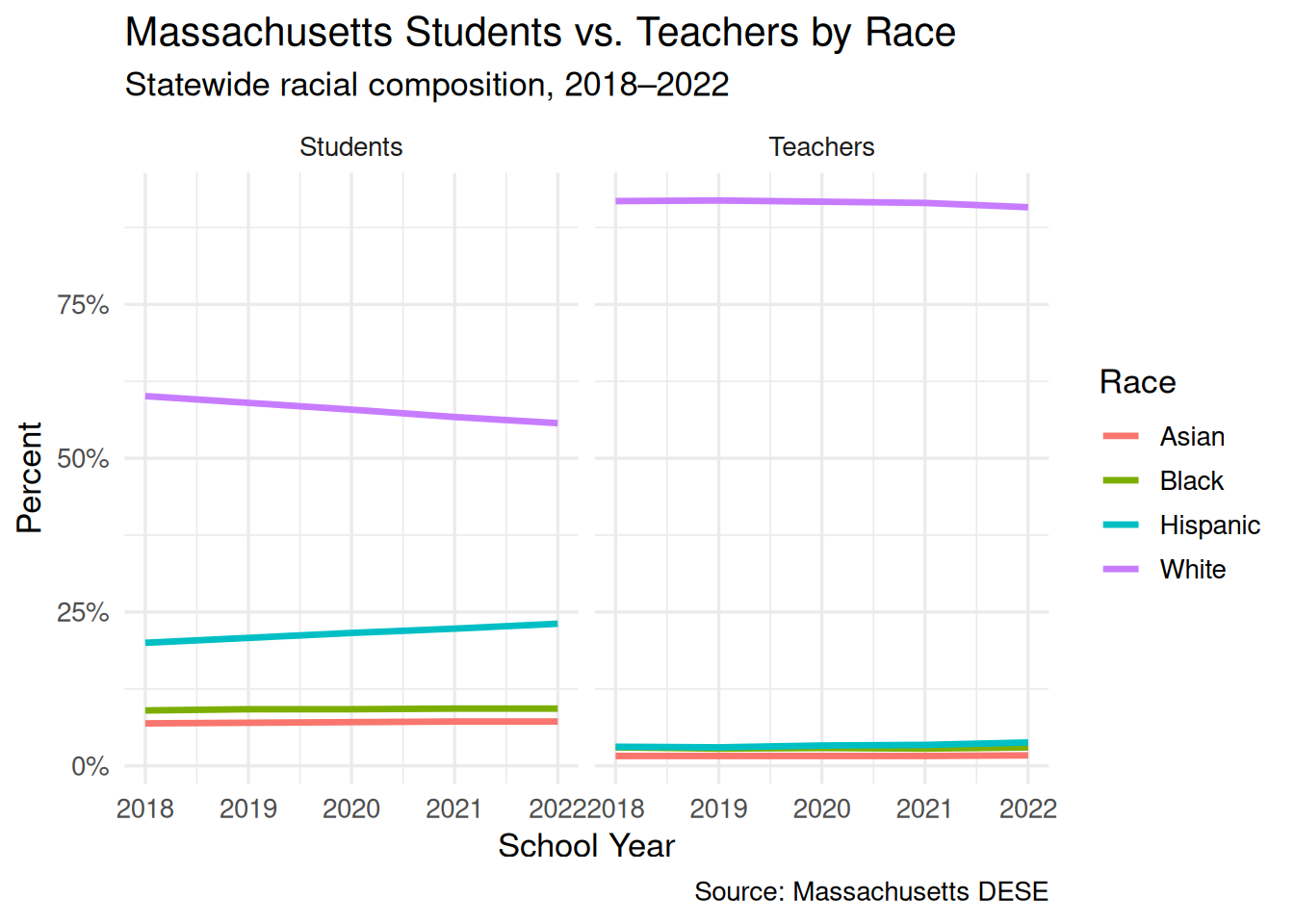
More than 90% of teachers are white, and roughly 80% are white women.
“Having 80% white women is not serving our boys, it’s not serving our black and brown boys specifically,” Madeline Zuck, a second-grade teacher working towards her Massachusetts licensure, said.
Zuck says that disparities in licensure pass rates could be contributing to the problem. “For some students, it becomes an education that fails them,” she says, referring to several studies which indicate a correlation between teacher-student racial disparity to student outcome.
Vivian Pittard, a Smith College student-teacher currently completing her practicum, added that “we get a certain type of teacher because a certain type of person can take the MTEL, and that doesn’t necessarily mean they’re a good teacher.”
The Massachusetts Tests for Educator Licensure (MTEL) was initially designed in 1998 to ensure that Massachusetts educators were capable of teaching the required curriculum and establishing a baseline for subject knowledge. But some educators question whether the exams are still serving their intended purpose, as well as if they are measuring what matters most in the classroom.
“There’s so much more to teaching than can be measured by standardized tests,” says Pittard.
“They measure whether you can pass a standardized test in reading and writing and math and science and history. They don’t measure why they can teach those things,” she said, “and those are different skills.”
For many aspiring educators, there is a financial barrier in the way as well. Each MTEL exam costs $139, with every license requiring several exams.
Zuck said that a large part of the process has been about time and money.
“It’s almost like an exercise of accessing an extra $750 and 3 free Saturdays and childcare to go and take the test,” Zuck said.
Pittard shared a similar sentiment, mentioning that Smith College pays for students to take each MTEL exam on their first try, and if they did not, she “certainly wouldn’t have time to make $750 to pay for the tests.”
The licensure process is intended to protect students by ensuring competent teachers and maintaining standards. However, both Pittard and Zuck said professionalism should extend beyond testing. But, as racial disparities in MTEL pass rates persist, the question becomes what purpose the test is actively serving.
The MTEL was established to maintain educational standards. Nearly three decades later, they continue to determine who clears the bar, and who does not, but perhaps not in the way that was intended.
As racial disparities in pass rates persist alongside a widening gap between students and teachers, the MTEL continues to shape who enters the classroom and who does not.
Because licensure exams act as a gatekeeper into the profession, disparities in pass rates may shape who ultimately becomes a teacher in Massachusetts.