Arts Enrollment Declines After Middle School in Massachusetts
news
Author
Flora Resika
Published
Feb 22, 2026
With the aptly-named Drawing Act of 1870, Massachusetts was the first state to require drawing classes in public schools. The act responded to the increased need for industrial drawers- workers who could produce technical diagrams for machinery construction. While art education in schools began with a strong focus on industrial drawing, it has since shifted to teaching methods of creative expression.
The 2019 Massachusetts Curriculum Framework for the Arts requires public school districts to offer arts instruction. While the Drawing Act of 1870 was met with support, as it was believed that these skills were necessary for future workers and the economy would therefore thrive, it’s unclear if Massachusetts students and their families still see the value in enrolling in arts classes.
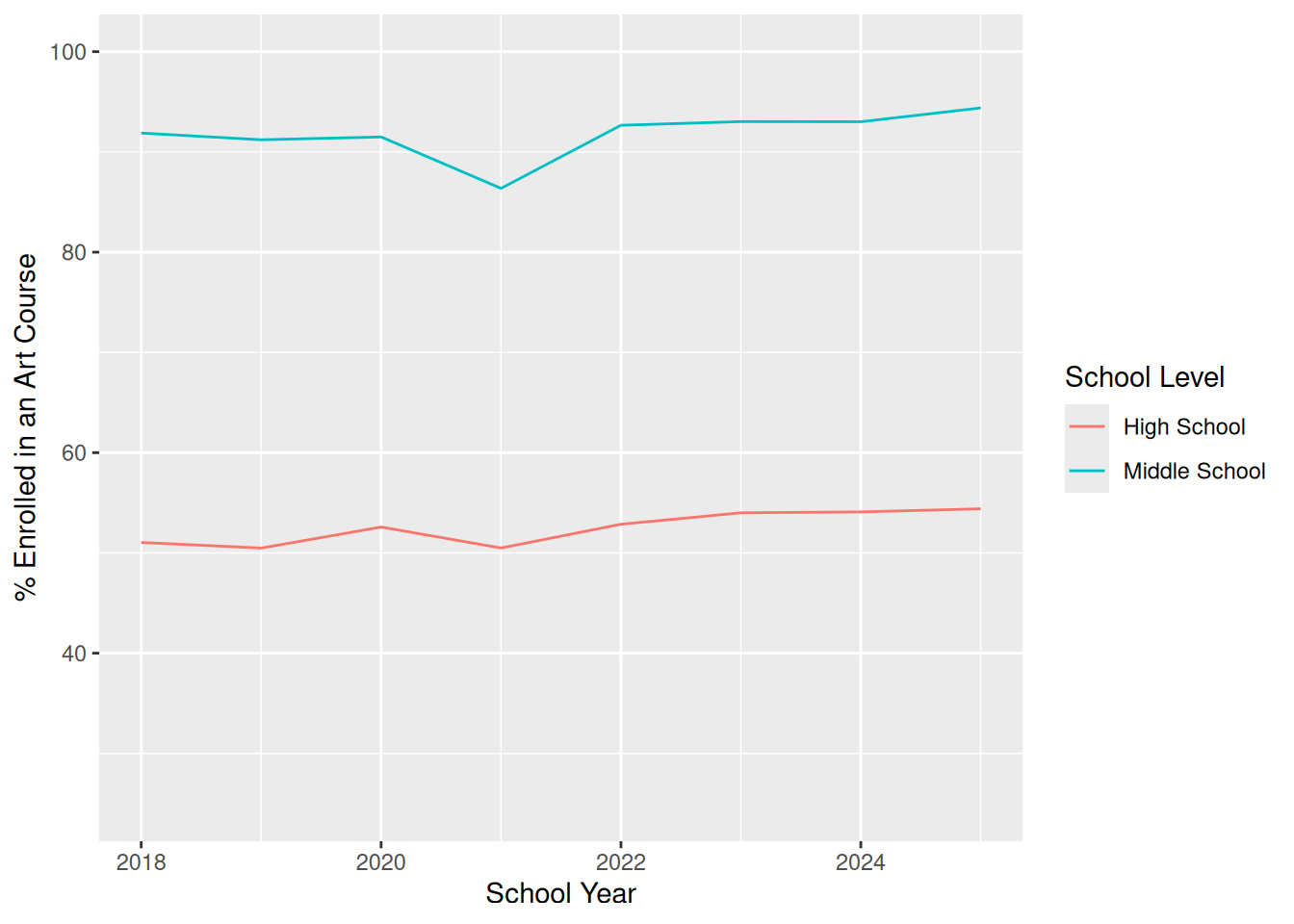
Data from the Massachusetts Department of Elementary and Secondary Education shows that over the last 8 years, the average percentage of middle school students who took art in each district has remained around 93%. However, the average percentage of high school art class participation has remained around 50%.
Code
ggplot(pct_by_grades, mapping =aes(x=sy)) +geom_line(aes(y=mean_hs, color ="High School")) +geom_line(aes(y=mean_ms, color ="Middle School")) +labs(x="School Year",y="% Enrolled in an Art Course",color ="School Level" ) +scale_y_continuous(limits =c(25,100))
We can see a slight dip in arts enrollment during the pandemic, but it has recovered since then. Overall, fewer high school students are choosing to take art classes. The drop can be explained by the fact that art is often mandatory in middle school curriculums, but becomes an elective in high school. Half of high school students across all districts are choosing not to put art in their schedules.
There is a stigma around art being an impractical thing to study. Research shows that arts programs “experience the pressure of being validated by demonstrating quantitative impact on academic outcomes” (Schneider and Rohmann (2021)). The skills that art develops in young people are not clearly captured by standardized testing, making it seem less useful. However, art education cultivates social and emotional skills that are just as important as technical ones.
“By nurturing creativity and encouraging originality, art education prepares students for success in the 21st century workforce, where innovation and problem-solving skills are highly valued”(Lukaka et al. (2023)).
I spoke to Max, a graduate of Northampton High School, about her experience taking art classes in high school. She took a studio art course in her first year, and a digital photography class in her sophomore year.
“The digital photography class definitely helped me with deciding what I wanted to do in the future. I still use what I learned in that class in my film classes here at Smith.”
Max explained how she is grateful that her school had the resources to offer a wide range of arts courses, and she wishes she took more of them. She noted that art was quite relaxing and a nice break from her other coursework. Max’s experience shows that at schools with robust arts programs, students can maintain balance in their schedules and explore possibilities for their futures.
While art enrollment drops from middle school to high school, half of high school students are still choosing these classes. Those who do pursue the arts gain creativity and empathy, which are more important than ever in a world with complex social problems.
Schneider, Verena, and Anette Rohmann. 2021. “Arts in Education: A Systematic Review of Competency Outcomes in Quasi-Experimental and Experimental Studies.”Frontiers in Psychology 12: 623935. https://doi.org/10.3389.