For Lorelai Eidswick, a 2024 graduate from Franklin High School, returning to the classroom following the pandemic was less of a continuation and more of a reset. She described this time period as one of “stagnant growth,” saying “it wasn’t just missing class, but rather a social and academic break in routine.” Without consistent reading, the writing of essays, and sustained literacy practice, Eidswick says her “stamina for learning had plummeted,” making the transition back to school that much harder.
Her experience reflects a broader pattern that has started to emerge in standardized testing data across Massachusetts. Recent Massachusetts Comprehensive Assessment System (MCAS) data suggests that English Language Arts (ELA) proficiency levels in Hampshire County have failed to recover from the pandemic and may, in fact, still be declining.
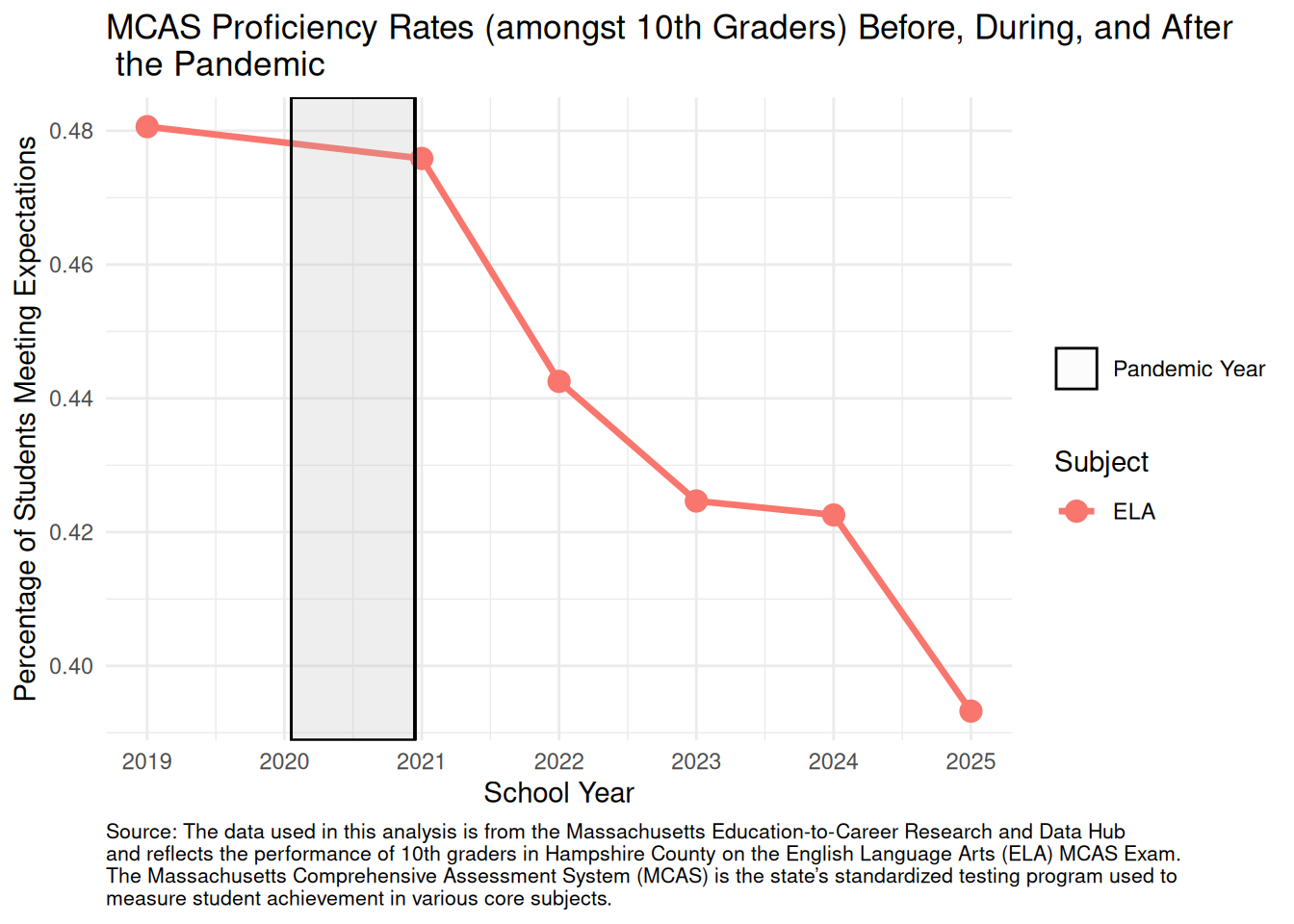
In 2019, before COVID-19 shut down schools, over 48% of 10th graders met expectations for the ELA MCAS exam. The MCAS divides student performance into four levels, where “meeting expectations” indicates grade-level proficiency. As the pandemic got underway, proficiency levels began to drop, with the sharpest decrease being seen in 2022. As of last year, the proficiency level had dropped to below 40%, illustrating nearly a 9 percentage point decline since pre-pandemic levels.
The shaded region, highlighting the pandemic year, illustrates the start of a downward trend. Such a pattern is not unique to Hampshire County. The National Assessment of Educational Progress (2024) has documented similar post-pandemic trends of declining reading scores.
This data reflects a wider concern among educators that literary skills may have taken a big hit due to the lack of structure and sustained practice. The foundations of reading and writing habits are developed through routine and regularity. Brown University economist Emily Oster (2021), who studies education and child development, noted that “learning is built on consistency,” emphasizing the necessity for routine classroom instruction in the development of literacy skills.
Eidswick reiterated this idea as she described that teachers were trying to “move forward, while reviewing things we should’ve already known”. This rushed environment made it difficult for students to fully engage with new material as they were trying to simultaneously brush up on previously introduced skills.
However, some instructors warn that MCAS scores should not be the sole measure of student progress. The National Education Association (2023) states that “standardized tests are an inaccurate and unfair measure of student progress.” They argue that standardized testing only captures part of the story towards recovery. It fails to highlight changes that schools have made, including the implementation of tutoring programs and adjusted curriculum, to help fight against the learning gaps that have formed.
Nevertheless, this trend is difficult to ignore as very little improvement has been observed. Educators are keeping a close eye on the cohorts of students whose high school years were disrupted by the pandemic. Will their literacy levels return to pre-pandemic trends or is there a bigger issue at hand?
Despite the pandemic being over for students like Eidswick, the shift back to “normal” is proving to be a harder issue than expected.
References
Emily Oster. 2021. Evidence-Based Approaches to Disciplining Children. https://parentdata.org/kids/covid-break-ish-discipline/.
National Assessment of Educational Progress. 2024. NAEP 2024 Reading Assessment: Grades 4 and 8. https://www.nationsreportcard.gov/reports/reading/2024/g4_8/.
National Education Association. 2023. Standardized Testing Is Still Failing Students. https://www.nea.org/nea-today/all-news-articles/standardized-testing-still-failing-students.