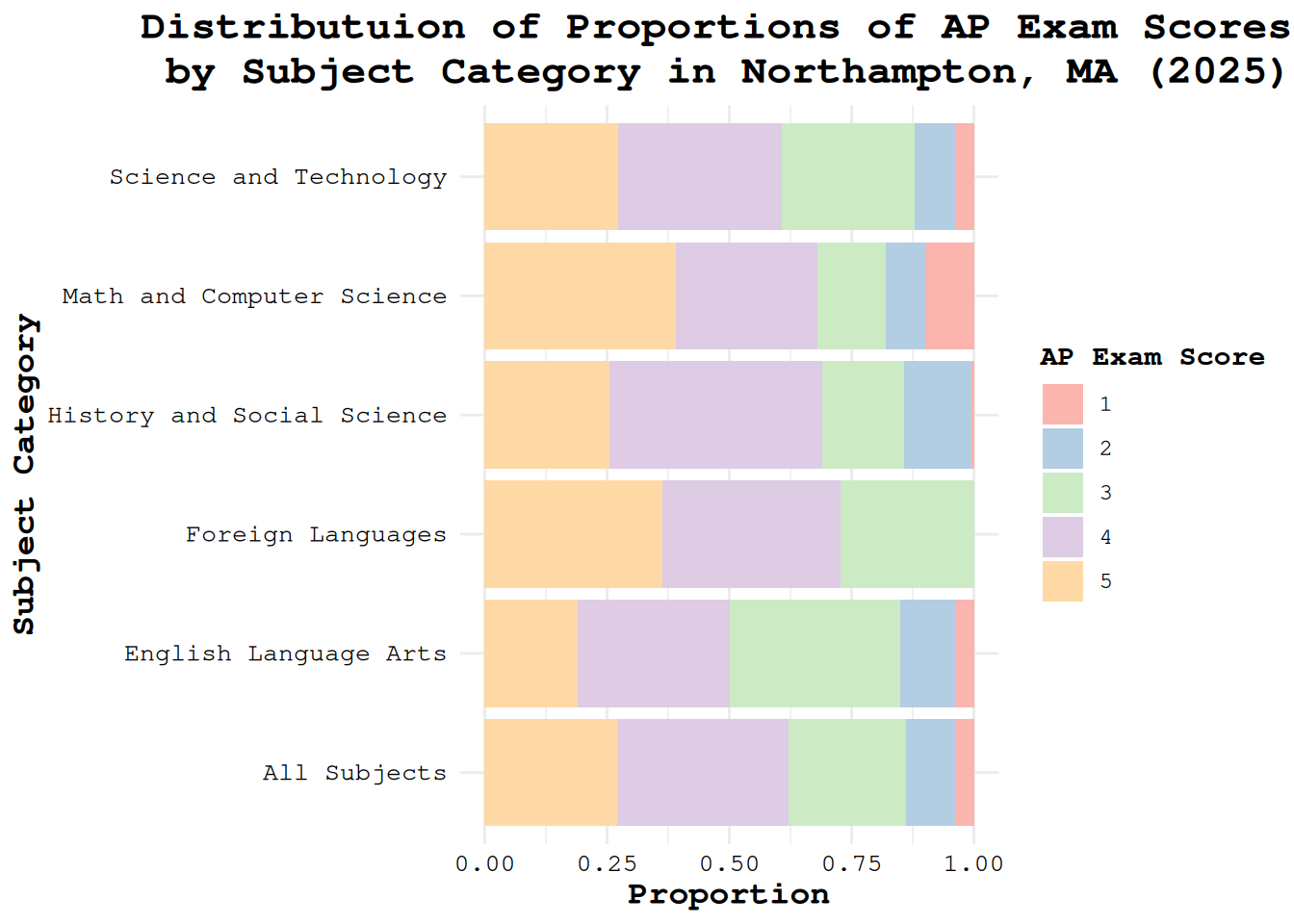
In 2025, Northampton High School students had higher average scores than other districts in Massachusetts in College Board’s Advanced Placement exams, a common marker of accelerated student achievement.
This raises important questions about the impact of educational approaches on student exam performance, educators say.
Every May, thousands of students in the Commonwealth of Massachusetts participate in the College Board’s Advanced Placement exams. These exams range in subject areas: from English, to foreign languages, to social studies, to mathematical and computer sciences, to science.
Using data from the Massachusetts Education-to-Career Research & Data Hub, we examined both Northampton’s and other district schools’ AP scores using the “Advanced Placement (AP) Performance” dataset.
For context, on College Board’s Advanced Placement exams, students can score from 1-5, with each score equating to a different recommendation from College Board for a student’s qualification for college credit. 1 is considered “no recommendation”, 2 is considered “possibly qualified”, 3 is considered “qualified”, 4 is considered “very well qualified”, and 5 is considered “extremely well qualified” (Patterson & Ewing, 2013).
Overall, Northampton out-ranked the state in the majority of subject categories. Across all subject categories, excluding English Language Arts, Northampton students scored 5’s anywhere from 5 to 15 percent more often than the overall state. In the majority of subject categories, fewer than 1 in 20 students scored a 1 on their exam in Northampton, but up to 3 times that many students scored a 1 at the state level.
At both the local and state levels, students most commonly scored a passing 4. Northampton more commonly got this impressive score, approximately 35 percent, but less than 30 percent of the state did. See more below.
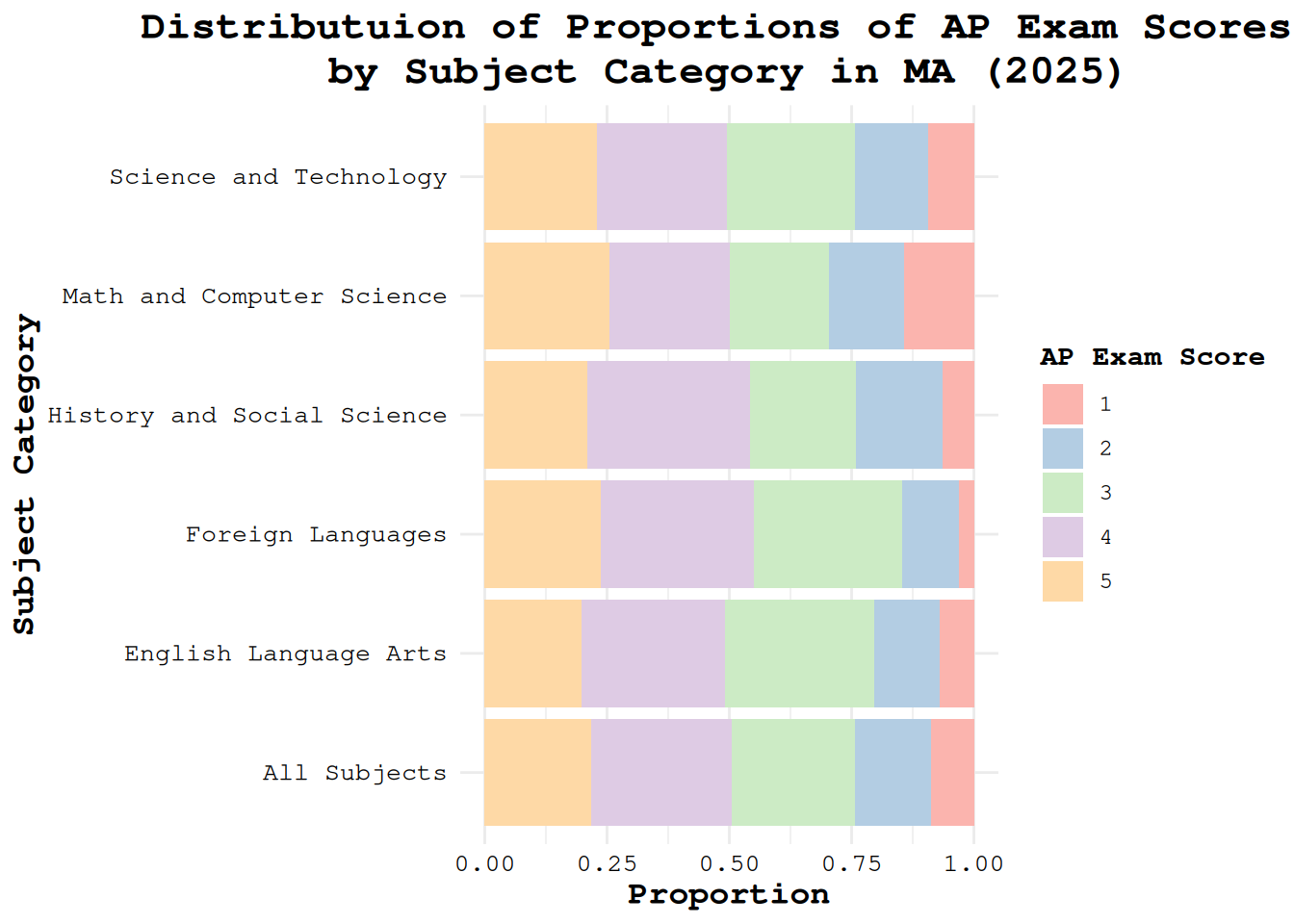
Northampton most stood out in History and Social Sciences, Foreign Languages, and Math & Computer Science with pass rates exceeding 85 percent. All of these subjects are vastly different in nature. This raises the question: Why is Northampton succeeding so much in their scores?
Northampton Public Schools recently released their 5-year Public Schools Strategic Plan. This plan outlines the goals of the district which includes the continued use of the SEL curriculum (Belliveau, 2024). The SEL curriculum focuses on community, collective learning, emotional health, identity, and empathy in education (Waajid et al., 2013).
Cheryl, a local standardized testing coordinator with over 20 years experience in education, says: “Such holistic curriculums are becoming increasingly common in education, as they have been found to produce more well-rounded students, and improved testing scores across the board.”
With this, it appears that Northampton’s curriculum might be a contributor to their high AP scores.
Cheryl explained: “Curriculums, such as the SEL curriculum, have become significantly more common, but are still not fully implemented in the majority of schools. In my experience, schools with the SEL curriculum, or similar holistic curriculums, tend to score better than other schools.”
Cheryl finished our interview saying: “I think Northampton is a phenomenal example of the benefits of holistic education curriculums, and I hope to see more schools implement such curriculums, as I believe they’re tied to improved student testing performance.”
References
Belliveau, S. (2024). Strategic plan 2024-2029: Canadian humanitarian response network.
Patterson, B. F., & Ewing, M. (2013). Validating the use of AP exam scores for college course placement. Research report 2013-2. College Board.
Waajid, B., Garner, P. W., & Owen, J. E. (2013). Infusing social emotional learning into the teacher education curriculum. International Journal of Emotional Education, 5(2), 31–48.