As the housing affordability crisis in Western Massachusetts continues to worsen, even those considered to be some of the most privileged and educated members of our community are struggling to afford homes in the area.
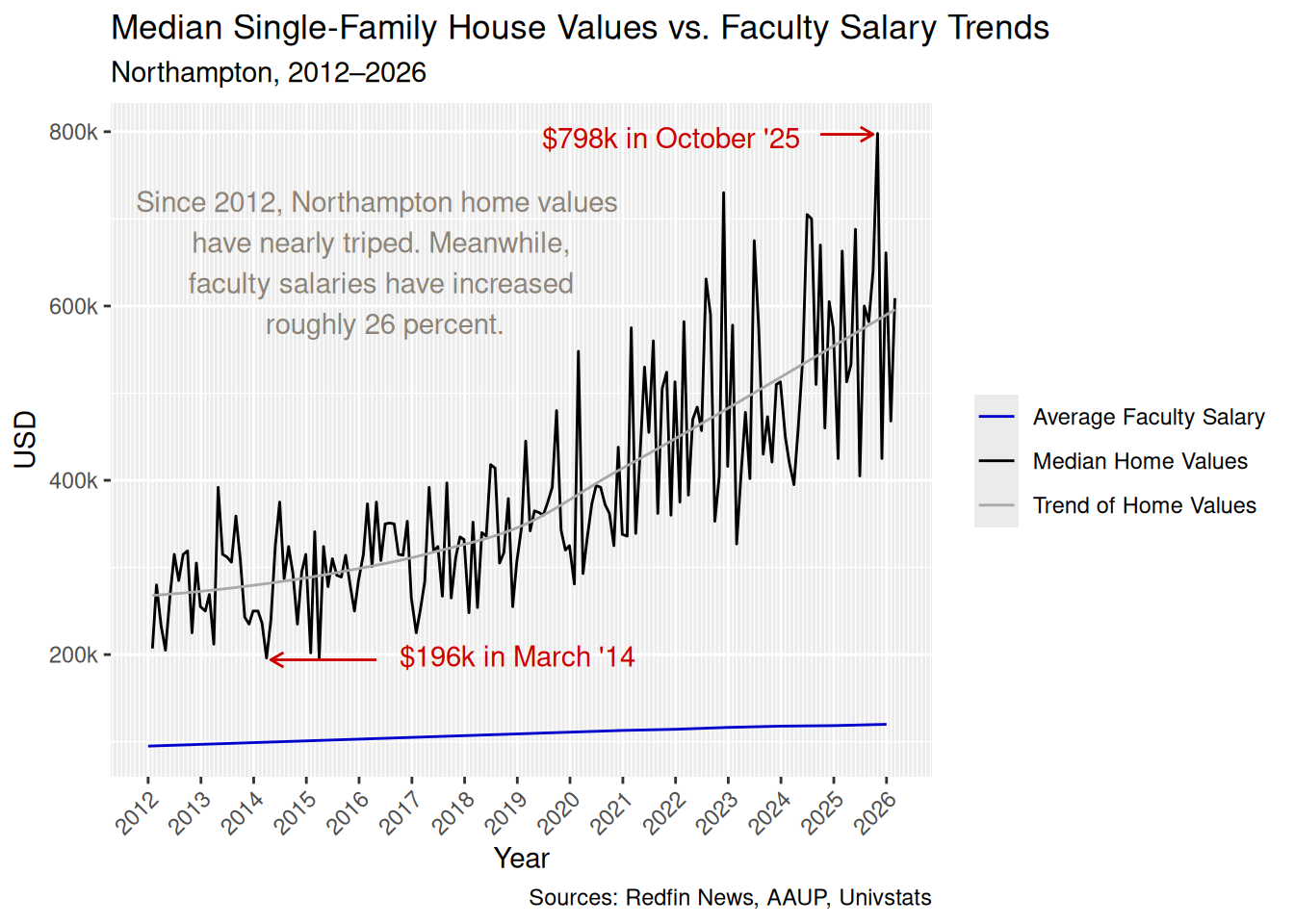
Many of Smith’s faculty members, especially junior faculty, simply can’t afford to buy property in Northampton. The median cost of a single-family home in Northampton has nearly tripled since January 2012. Because of this, many new faculty members have resorted to renting or purchasing houses elsewhere, some in neighboring towns and others with commutes over 30 minutes. With Northampton’s growing demand for housing in tension with limited rental units, Smith is scrambling to keep faculty connected to the community they teach in.
“It’s kind of funny; amongst Smith faculty you can basically tell what year they were hired based on how far they lived from campus,” said former Smith professor of Government and Statistical and Data Sciences, Scott LaCombe. Newer professors tend to own homes in farther-away towns, while tenured professors tend to own homes much closer to campus.
LaCombe started at Smith in the fall of 2020 and lived in faculty housing until February of 2024, when he purchased a home in Holyoke with his family. His house sold for 350 thousand dollars, and at the time, the median price of a single-family home in Northampton was 420 thousand dollars.
Last Spring, LaCombe and his family moved to Missouri, partially due to high housing costs and underperforming schools in Holyoke, and partially to be closer to family.
“If we had been able to afford it, we would have stayed in Northampton, but there was just no universe that we were going to be able to be homeowners long term. Even in towns like Holyoke, which are more affordable, you can see real estate prices just everywhere in Massachusetts are just skyrocketing.” LaCombe said.
While many of the junior faculty members rent or own property in surrounding towns, senior faculty and staff who have been in the area for many years were often able to buy their homes before the prices climbed to their current levels. Many of these people bought their homes over 10 years ago, when housing prices were much lower. Now, a lot of faculty consider themselves lucky for being able to own a home close to campus.
An analysis of housing data shows that since 2012, median single-family home values in Northampton have increased exponentially, with the highest median single-family home value being nearly 800 thousand dollars in October of last year.
The lowest median home value was in March 2014, with prices dipping just below 200 thousand dollars.
As of February, the median cost of a single-family home is 609 thousand dollars, which is nearly triple the median in January of 2012. On the other hand, average faculty salaries have only increased 26 percent on the same timeline.
Adam Dunetz, one of Smith’s dining managers, said that he bought his home for 190 thousand dollars in 2011. “It was even a good deal then!” Dunetz said. His street dead ends to a sewage treatment facility, which, although off-putting to other buyers, worked in his favor. According to Dunetz, home values in his neighborhood have increased exponentially since then.
“We’ll probably live in this house for the rest of our lives,” Dunetz said, expressing minimal hope that his family will ever be able to buy property again in the current Northampton market unless something changes drastically. He explained that such good deals are becoming rarer and rarer and that his family is effectively trapped in their current home due to the Northampton housing market.
Jeremy Bonios, the retail dining manager for the Campus Center and Compass Cafe, has owned property in Northampton for ten years. He moved here from Los Angeles eleven years ago and was able to buy a home after renting for just one year in the area.
Bonios owns multiple rental units in a multi-family home, which he manages with his wife. They have witnessed both sides of the increase in housing costs, and he expressed that they have been both positively and negatively impacted.
“Property values are increasing, and while it is good in the long run, in my immediate life I am paying more property taxes,” Bonios said. Along with the increase in property taxes, Bonios reports that his homeowner’s insurance increased by almost 30% in just one year, drastically increasing his monthly expenses for his property.
These rising costs have forced landlords to increase rent in order to keep up with their own expenses. “A lot of these landlords are people like me,” Bonios said. “They have had their property taxes and also homeowner’s insurance go up, and so that, in turn, reflects in the cost of rent.”
Many newer faculty members with a desire to own property, like LaCombe, have turned to neighboring towns with much lower prices. Ab Mosca is a second-year professor at Smith who owns a home in Holyoke. Prior to their move to Holyoke, Mosca rented a 2-bedroom apartment in Northampton for $2100 a month. They expressed that they would have loved to live in Northampton long-term but opted to purchase somewhere more affordable.
“I could not afford to buy anything in Northampton, Holyoke was the only place that was affordable and still a reasonable drive for me,” they explained. “Northampton is much more expensive than Holyoke; you get much less space for your money.” Even in Holyoke, Mosca paid 350 thousand dollars for their home and lives with a roommate to help cover the cost of the mortgage.
Smith College has various programs in an effort to help faculty afford to live in the area. The college owns a total of 35 buildings and 86 rental units through 3 College Rentals, which services faculty from Smith, Mount Holyoke, and Amherst College. About half of the units are occupied by staff and the other half are occupied by faculty members.
“Quite honestly, I think that the need outpaces the stock. The need out there is much more than we have for availability,” said Larry Syder, AVP of Campus Services, Operations & Maintenance.
In November, the Daily Hampshire Gazette reported on Smith College spiking rents for tenants by nearly 28%. The college responded to the article by saying: “The rental rates are set in an attempt to stay in line with the current market, and the revenue is used to cover costs such as property taxes, updates, and maintenance. While Smith does not speak to the details of individual leases, the college does comply with the terms of all documented agreements related to its rental properties.”
Anne-Marie Smzyt, VP for Human Resources, acknowledged the balance between affordability and profit for the college. “People are focused on what the percentage is, not necessarily what the dollar amount is,” said Smzyt. “We’d love to make our housing as close to nothing as we possibly can, but that’s not reality.”
Smith College also offers a second mortgage program to try and make buying a house more attainable. The program is a legally binding lien document on the house and is repaid to Smith over the course of the 30-year mortgage. This program is available to full-time faculty who are purchasing their first home and are relocating to Northampton for their employment.
The college offers up to 70 thousand dollars to eligible faculty members, which can be put towards the down payment of the home, buying mortgage points, or reducing their monthly mortgage payments. According to Szmyt, 64 people currently participate in the program, a number that has remained relatively stable during her 7 years at Smith.
“We’ve had many conversations, and we do often, if 70,000 is the right amount of money,” said Szmyt. “We’re at a point right now with all the financial headwinds coming in at the college that we want to be really careful that we’re not overextending.”
Payments to the college for the second mortgage along with interest are deducted from each paycheck to simplify the process. “It’s not a check people have to write out; it’s literally taken out of their paycheck, so it just becomes that much easier for people to make sure they’re meeting their obligation,” says Szmyt.
Even with the second mortgage program, many Smith faculty have had no choice but to rent in order to be close to campus. Gillian Beltz-Mohrmann, assistant professor of Physics and Statistical and Data Sciences, is in her first year at Smith. She explained that she and her husband cannot afford to own a home in Northampton, so they rent through Smith College. She said her experience with Smith as a landlord has been very positive but also said that she “got lucky.”
Similarly, Rebecca Kurtz-Garcia and her husband moved to Northampton three years ago from California when they both joined the faculty. They rented through Smith College as well and shared the sentiment that the experience has been positive. Kurtz-Garcia, an assistant professor of Mathematics and Statistical and Data Sciences, mentioned that when she interviewed, her fellow faculty members told her about the faculty housing that Smith offered and recommended that she look into it.
“We did try to look on our own, because a lot of the Smith housing didn’t allow dogs, and we have a dog.” Kurtz-Garcia said. But the ease of going through Smith outweighed the limited number of properties, and the couple ultimately decided to pick from the short list of Smith-owned properties that accepted dogs.
In the end, Northampton’s housing crisis isn’t just about the rising prices or shifting markets; it’s also about the future of a community built around a college that depends on its people. As long as faculty are pushed farther from campus, Smith risks losing something harder to quantify than mortgage payments or rental stock: the everyday presence of our future generations’ educators in the community. And unfortunately, Northampton’s housing prices reflect broader national trends, not just local policy failures. Northampton’s choice to adapt or hold tight to the status quo will shape not just the city’s housing landscape but also the future of the community that depends on it.
“For a liberal arts college you kind of want faculty to be close, right?” said LaCombe. “Because it’s more of a community. I think that it’s also a loss for Smith to not have the faculty invested in Northampton.”