Ed Lesko’s goal was to become a millionaire by the time he was 40 years old. “I succeeded at 42,” says Ed Lesko, now president of the Smith Vocational and Agricultural High School alumni association. Lesko graduated from Smith Voc with his certificate in carpentry in the class of 1969.
“I worked for a company for about probably five years and decided if they’re making money on me, I can certainly make money myself. So I started my own business and did that for about 20 years,” Lesko said. He then helmed a custom home building, remodeling, and roof repair business that employed between three and seven additional carpenters.
In Northampton, over the past five years, demand for admission to Smith Vocational and Agricultural High School has consistently exceeded capacity, with roughly two applicants for each available spot. The allure of starting a business is one of the many reasons why vocational school enrollment has increased by twenty-four percent since 2005 as more students pursue blue-collar career paths in the wake of a wobbling job market, according to Athol Daily News. Data obtained by the Shoestring show that Smith Voc students typically graduate with strong employment prospects, with as many as 53% percent going directly into the vocation of their studies, and another 16% pursuing continued education.
However, despite the high demand for vocational education, there are concerns amid recent hiring trends. Recent data from the Bureau of Labor statistics has found that hiring for blue-collar workers has slowed down. For example, the Federal Reserve Bank shares yearly trends for job hiring, and found hiring across the manufacturing sector has declined 40% since 2022. The slow-down is caused by a variety of factors, including the lack of available projects and slowing of commercial activity across the country, according to the New York Times.
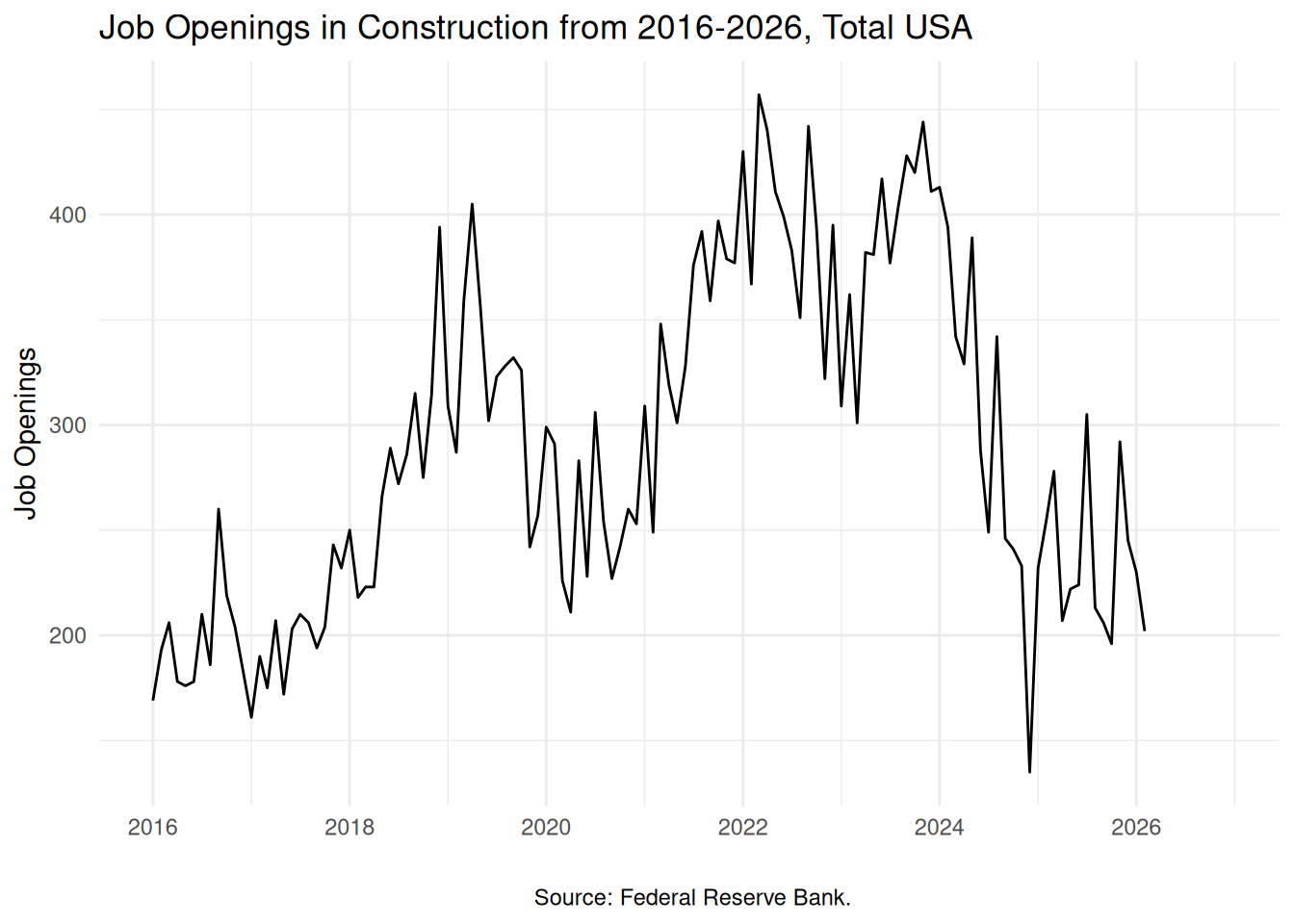
Notably, the Bureau of Labor Statistics—which has tracked job openings in the construction industry over the past 10 years—found a drop off in late 2024 for job openings.
However, Smith Voc principal Joe Bianca believes that a vocational education provides graduates with excellent employment opportunities, remarking that “our career fields are some of the last that AI would impact.” Some students are also coming from a background in the vocation they plan to focus on, such as owning a family farm or business.
Students attend academic classes for one week, and shop classes the next week, with fifteen vocations ranging from Health Tech to Animal Science. In their first year, Smith Voc students choose several vocations to try, before being placed into their final vocation based on grades and skill in that field.
After graduation, many graduates opt to enter the workforce immediately after high school. Over the past five years, compiled data from the Massachusetts Department of Elementary and Secondary Education shows that Smith Voc graduates planned to enter the workforce almost three times more often than traditional high school graduates in Massachusetts.
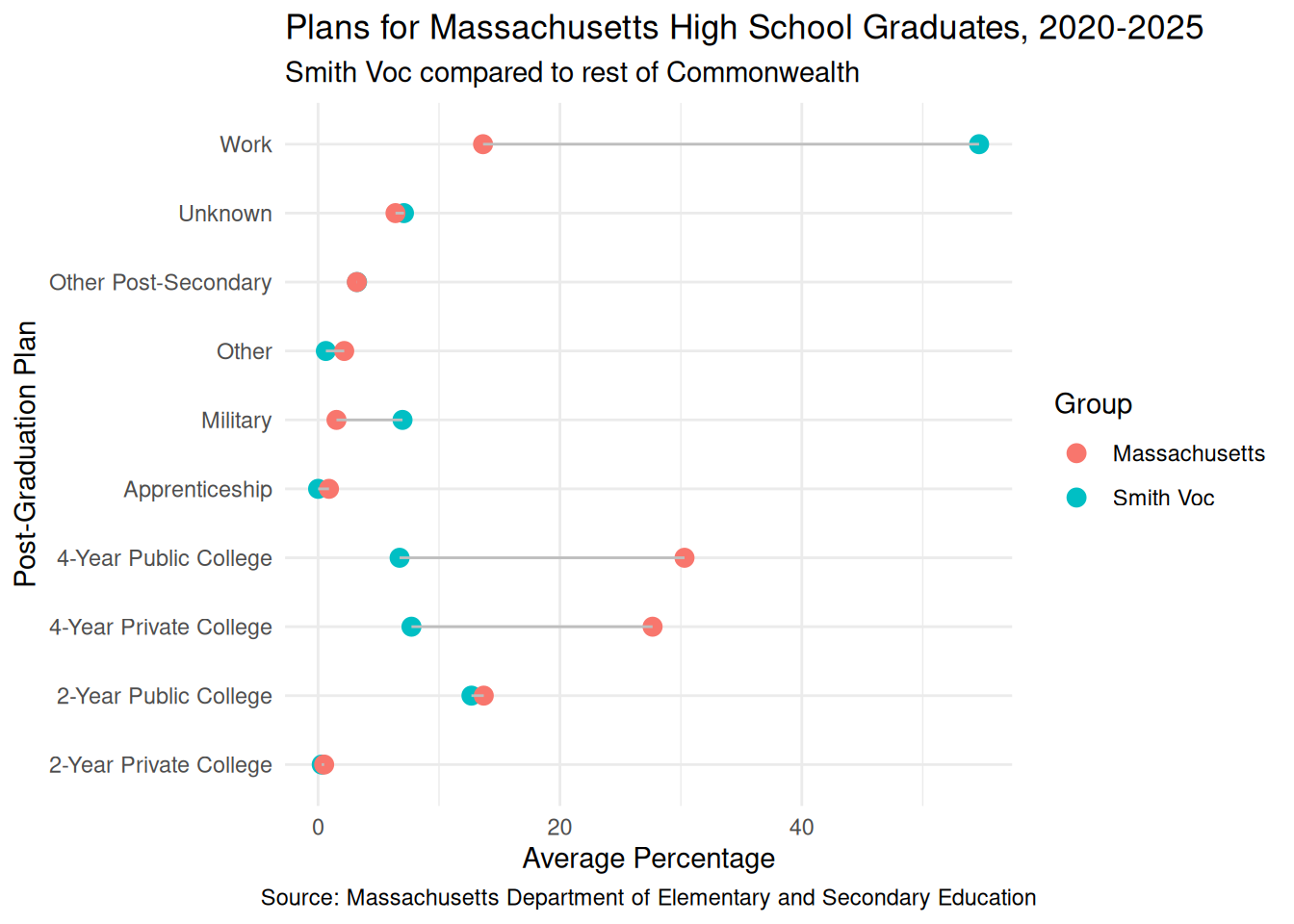
While many students plan to enter the workforce immediately after graduation, these plans can change after they walk across the stage.
Mandated by the Massachusetts Perkin V Law, Smith Vocational is required to track their students up to two years post-graduation. The students are categorized as being “Positively Placed” if they either attend postsecondary education or advanced training, military service or service program, or are employed related to their vocation.
Recent data obtained by The Shoestring from Smith Voc’s front office show what the 110 students from the Class of 2022 did two years after graduation in relation to their chosen vocation.
Plumbing and electricity sent the highest number of graduates towards employment while criminal justice and graphic communications sent the least.
Very few students faced unemployment after graduating from Smith Voc. From the class of 2022, only two students were unemployed two years after graduation.
Additional education for many of these fields entails furthering what students have learned at Smith Voc. For example, Smith Voc’s counselor’s believe a graduate in the Animal Science vocation may be better positioned for vet school programs than a student who attended a traditional high school, due to the hands-on knowledge from their shop class.
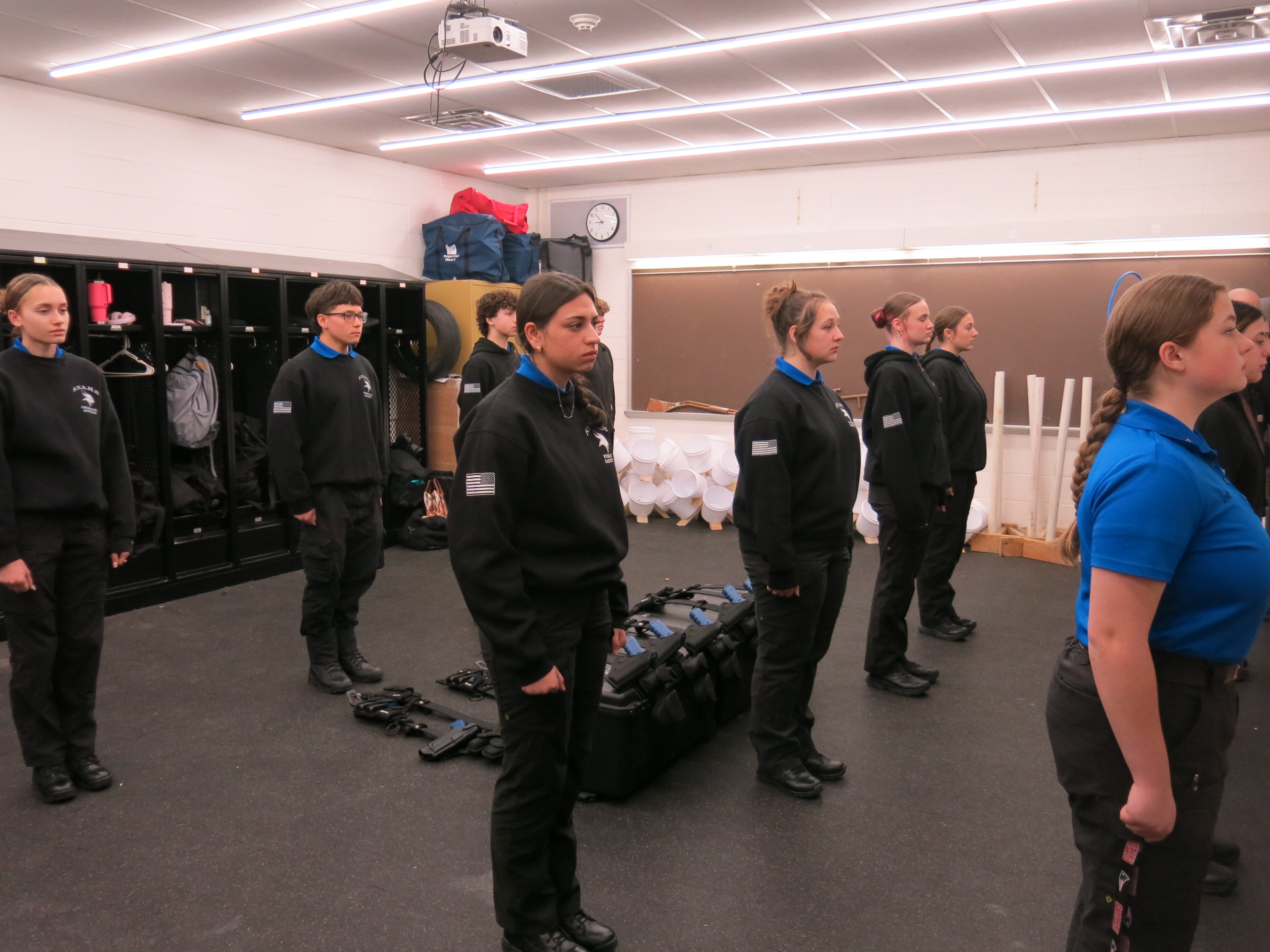
Criminal justice sent the most graduates into the military, which accords with the training those graduates received.
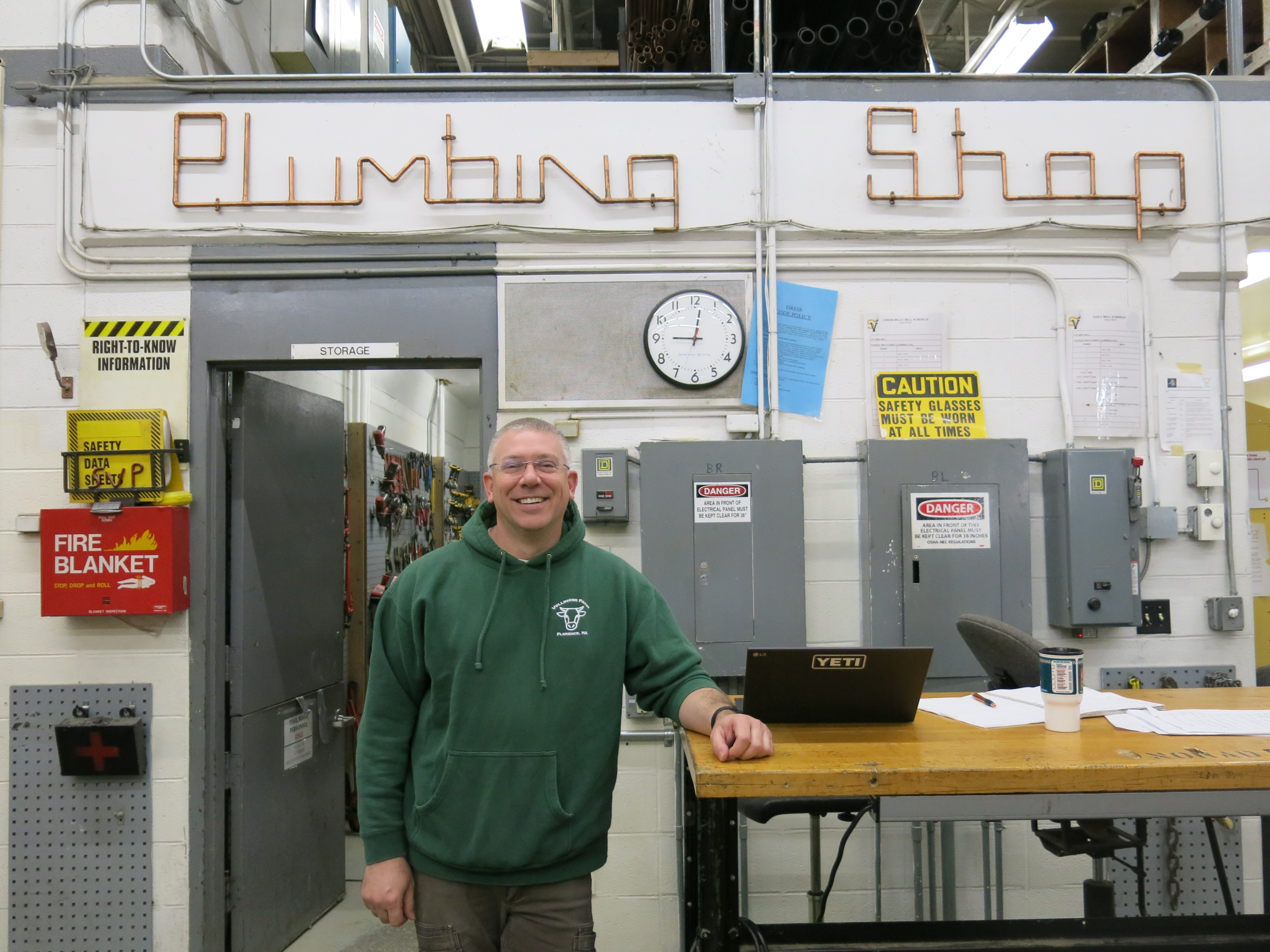
One of Smith Voc’s stand-out vocations is plumbing, yielding some of the most dedicated graduates who continue to stay in their shop. “Plumbing is one of three shops with the highest career placement. The students do not look back and they more often than not remain in that field,” says Bianca.
Plumbing students not only excel after graduation but also excel while attending Smith Voc. Vocational schools across the United States compete in an annual event called Skills USA where students showcase their skills in their given vocation and compete to be National Champions. The plumbing vocation at Smith Voc has had eight national champions, the most of any vocation offered, with the most recent being Dylan Fil in 2021.
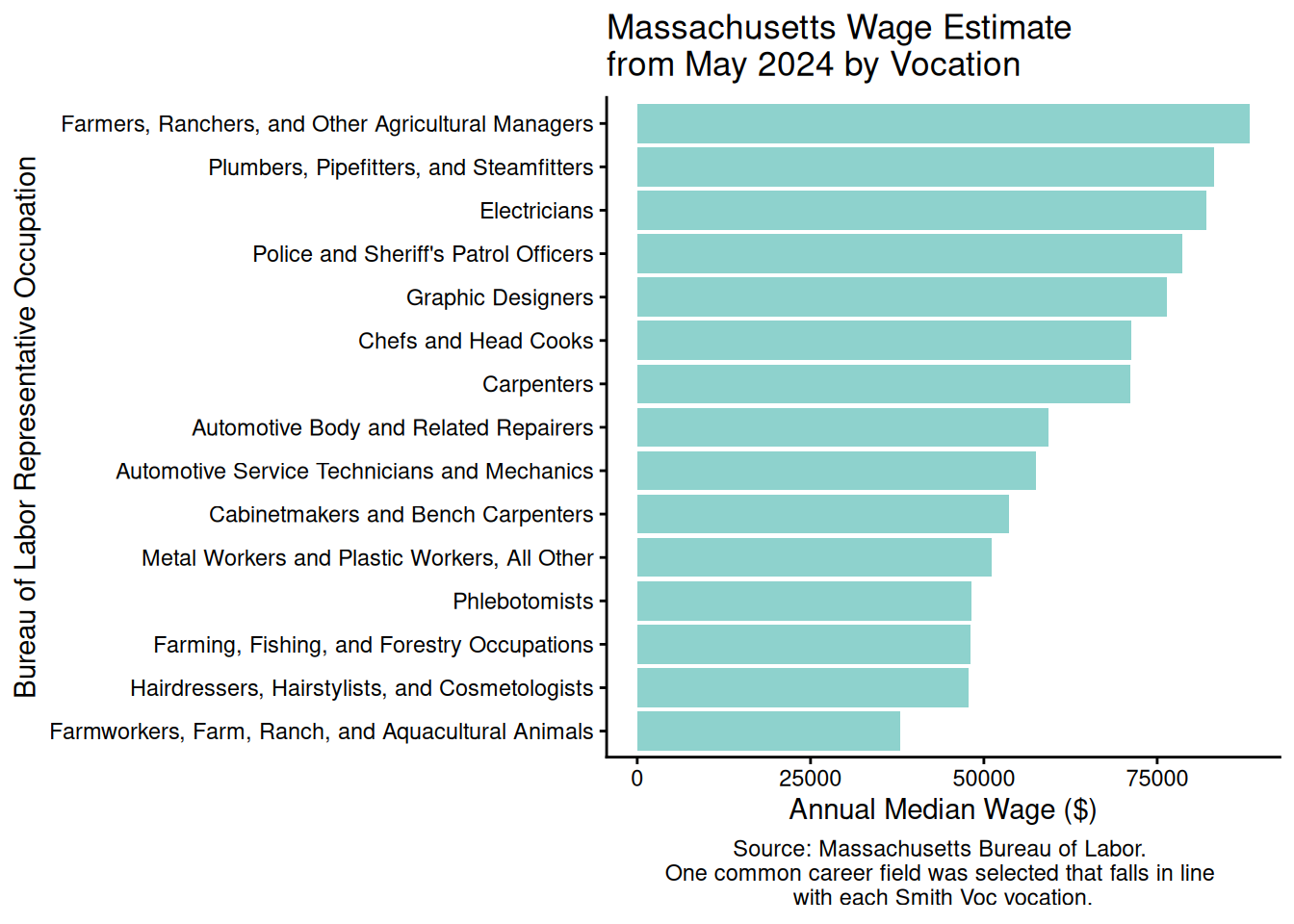
For plumbing graduates going into work associated with their vocation, the Bureau of Labor Statistics reported that the annual median income ranges from thirty-five to eighty-five thousand dollars.
Plumbing ranks second among Smith Voc shops for highest annual income, only below Agricultural Managers Meanwhile, cosmetology and animal science had the lowest annual incomes.
While plumbing students may have excellent job prospects, they are nexessarily devoting less time to more traditional academic work.
In 2025, the Department of Elementary and Secondary Education reported that Smith Voc tenth grade students scored below Massachusetts state standards in Mathematics, English Language Arts, and Science, for the Massachusetts Comprehensive Assessment System (MCAS) test, which Smith Voc 9th & 10th graders are required to take.
“In my case, some of the kids I have [worked with] were woefully unprepared in reading and writing,” says John Geryk, Northampton High School alum and owner of John T. Geryk Plumbing and Heating.
Others within the Smith Voc community are quick to defend the education students are receiving. “One common misconception about vocational schools is that there is some sort of lower academic standard for what’s going on in the schools,” says Hopper. “But it’s not exactly true, they need students who can do the same amount of work in effectively half the time.” Although test scores can be an effective measure of a student’s education, it does not always paint the full picture.
“There’s a lot of stigma about how Smith Voc isn’t as educational and smart, but I feel like I’m learning a lot. We have extra class periods of everything, so you do feel like you are prepared” says Dylan Hopper, freshman in the Animal Science vocation at Smith Voc. “I feel like I am very lucky to be getting this experience and education.”

Although a main draw to vocational schools is entering the workforce immediately out of high school, many students opt to continue their vocational training at a postsecondary level and make competitive applicants to prestigious colleges. “Students leave with their CNA [Certified Nursing Assistant] license, they leave with their phlebotomy license. And those are things that typical 17, 18 year olds are not having,” says Molly Alberti, one of Smith Voc’s School Counselors.
Even with these benefits, the decision to attend a vocational school can still be a complicated one due to the difference from traditional high schools. “The process of choosing [Smith Voc] was definitely difficult, in the sense that it put her outside the norm,” said William Hopper, parent of a Dylan Hopper and Statistics and Data Science Professor at Smith College. “We just made the decision, her mom and I, that choosing a high school has to be about your academics and your career.”
Almost half of cosmetology and automotive technology graduates choose to enter postsecondary education before the workforce. When graduates choose to continue their education at a postsecondary institution, it is not always due to disliking their vocation, but rather to better prepare themselves to enter their desired industry.
Harleigh Vertucci, a senior cosmetology student at Smith Voc, is one example. “My goal is to go to college, get my business degree, open my own salon, and once that’s all over, I would love to become an instructor at Smith Voc.”