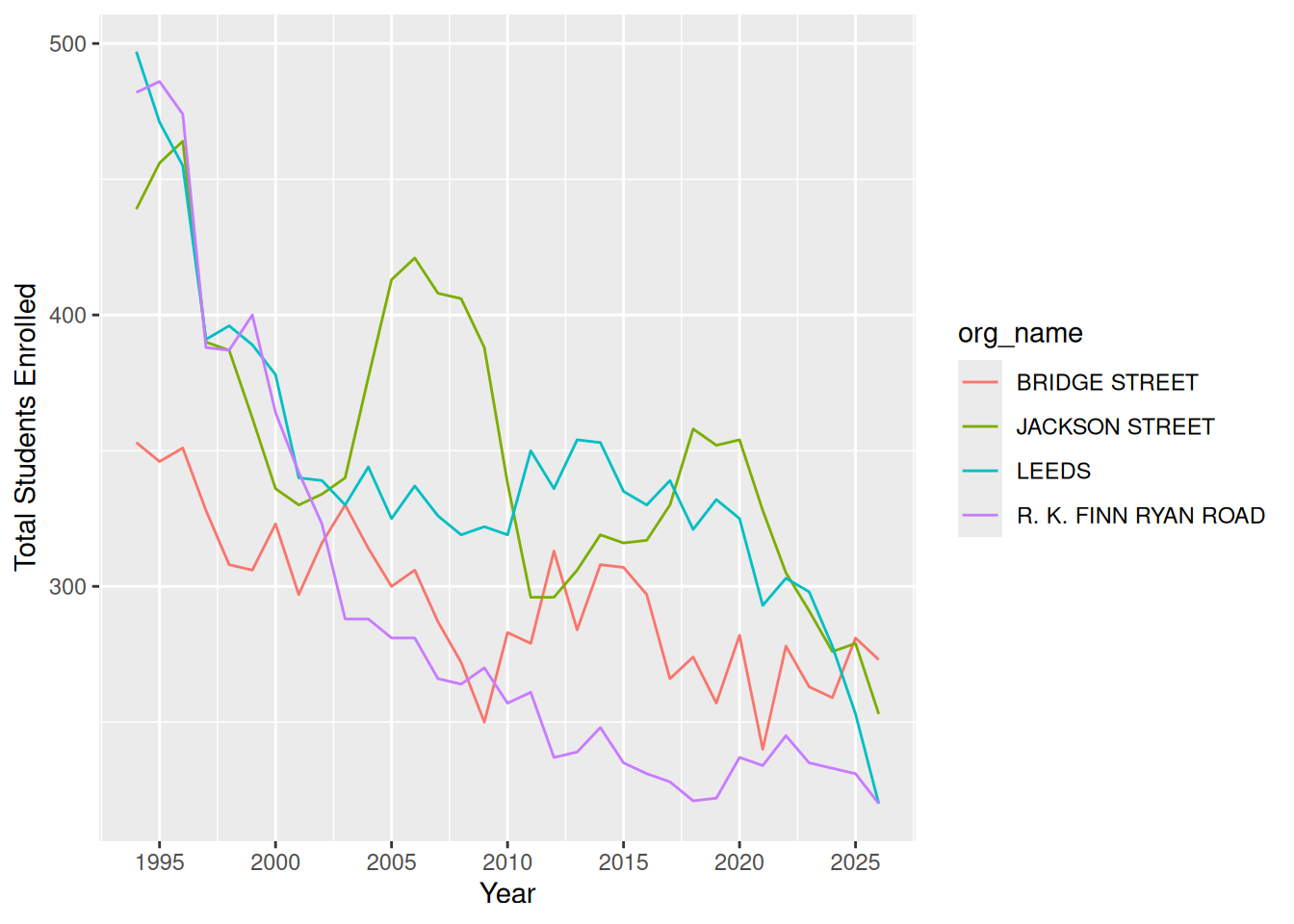
During the current 2025-2026 school year, data from the Massachusetts Education to Career Research and Data Hub shows that three out of the four Northampton public elementary schools are facing their lowest enrollment numbers to date (DESE 2026). Elementary enrollment is down nearly 20% since the 2019-2020 school year, and if current trends continue, these numbers will only decline further.
Jackson Street School, Leeds Elementary, and RK Finn Ryan Road School all have experienced their lowest enrollment this academic year. While Bridge Street had higher enrollment than last year, it’s still 21% lower than it was in 1994. Across the four elementary schools in the district, there are only 966 K-5 students enrolled in Northampton’s public schools this academic year, compared to the 1,771 students enrolled in 1994. That is a nearly 50% decline in enrollment over the past thirty-two years.
Under-enrollment in public schools can be extremely detrimental to the education system, since school funding is often tied to student enrollment. Fewer students can translate directly into reduced state and local funding, leading to budget cuts, staff layoffs, and even potential closings of schools.
Smith senior Izzy Fivel has been conducting research on junior kindergarten, a bridge program between preschool and kindergarten, since September. “This program would be helpful to connect preschools and kindergartens,” he said. “It would hopefully help boost declining kindergarten enrollment too.”
While researching junior kindergarten, Fivel has looked at kindergarten enrollment data for Hampshire county going back to 1995, and has witnessed the near-constant decline in enrollment. He expressed frustration with the difficulties of using education data to try and piece together the whole picture of why enrollment is declining.
“The numbers only tell us part of the story,” Fivel said. “When you only have the numbers, you can only make guesses about what’s actually going on. Often you have to wait a few years after the fact to be able to understand what those numbers mean.”
This uncertainty makes it difficult for district leaders to respond in real time. While enrollment figures clearly show a decline, they do not reveal the full picture behind the movement of families or the decisions parents are making in regards to their children’s education.
“When the numbers drop at certain schools and don’t rise at others, we really don’t know where those children went.” Fivel noted. Students may move to other districts, enroll in private or charter schools, move to other states or countries, or start being homeschooled.
There are also many other factors that could be contributing to the drop. Shifts in housing affordability, remote work flexibility, and families relocating during or after the pandemic have reshaped many communities nationwide. In Western Massachusetts, rising housing costs and limited houses on the market might make it more difficult for young families to move into the area. If fewer families with young children are settling in Northampton, elementary enrollment will naturally decline over time.
Schools are often central to a community’s identity, serving not just as places of learning but as gathering spaces, support systems, and sources of stability for families. When programs are reduced or schools risk consolidation, students can lose access to enrichment opportunities, individualized support, and extracurricular activities that shape their overall development. Teachers may have fewer resources to meet diverse learning needs, and families may feel uncertainty about the future of their neighborhood schools. Over time, these changes can alter the character of a district and affect how attractive it is to prospective families considering a move to the area, only furthering the decline.
References
DESE. 2026. Enrollment: Grade, Race/Ethnicity, Gender, and Selected Populations. Massachusetts Education- to-Career Research; Data Hub. https://educationtocareer.data.mass.gov/Students-and-Teachers/Enrollment-Grade-Race-Ethnicity-Gender-and-Selecte/t8td-gens/about_data.