Passions and Professions: What is the Difference Between What Massachusetts Public High School Graduates From Different Class Years Make?
news
Author
Steph Krieger
Published
Feb 22, 2026
Choosing a major and a career typically involves balancing passion alongside financial benefit. The cost of a college education can exceed tens of thousands of dollars, says the Education Data Initiative. So for families relying on the money being earned post graduation, they need to be certain that the investment will result in profit once entering the work force.
New Massachusetts public high school research shows that the income different career industries make has shifted over the past several years.
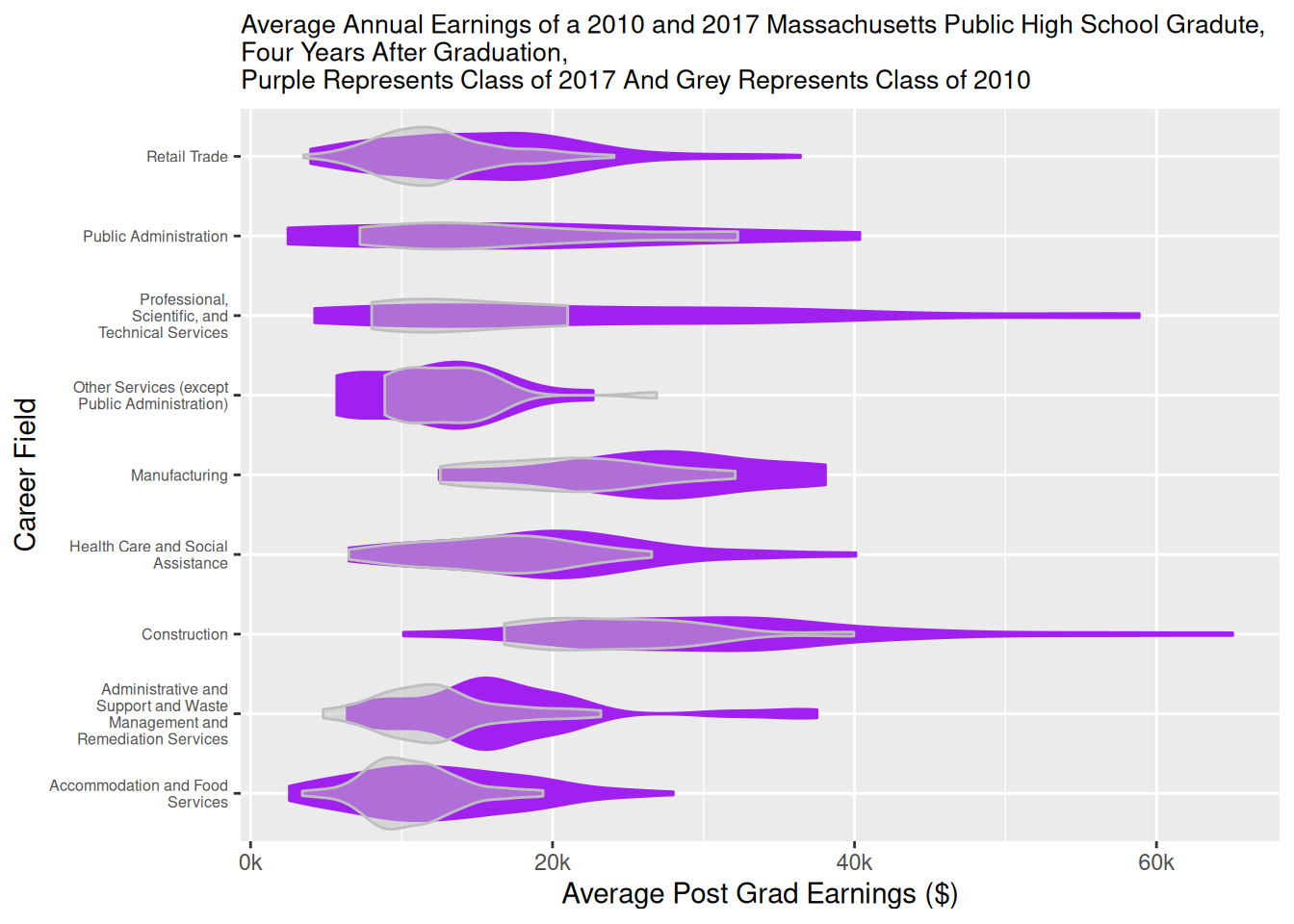
The Massachusetts Education-to-Career Research and Data Hub, a state-run organization that tracks long-term education and career information, calculated the average cumulative earnings of 2010 Massachusetts public school graduates compared to 2017 graduates over 4 years. The data show the relative incomes of individuals working full-time in different career fields. The information may help current high school students narrow down potential careers.
Typical four-year colleges require their students to declare a specific field they want to study, known as their major, which often leads to the career they have post-graduation. Students base their majors on many factors, but new data suggests future salary may be an important factor for students to consider.
“I definitely talked to people who chose [specific careers] because it makes the most,” said Sienna Barney-Yapo, a 2025 graduate from the Massachusetts public high school Boston Latin, who now attends Smith College, “If you are driven by money this information could be helpful.” Barney-Yapo has always had interest in engineering, a field likely to fall under Scientific Services–where graduates from 2017 earn up to $60,000, one the highest of all fields. So having this information made accessible to her could help justify the cost of pursuing an engineering degree.
Code
ggplot(earnings_total,aes(x = average_earnings, y = naics_description)) +geom_violin(data = dplyr::filter(earnings_total, hs_grad_year =="2017"), color ="purple", fill ="purple") +geom_violin(data = dplyr::filter(earnings_total, hs_grad_year =="2010"), color ="grey", fill ="grey", alpha =0.5) +scale_y_discrete("Career Field", labels = scales::label_wrap(25)) +labs(title ="Average Annual Earnings of a 2010 and 2017 Massachusetts Public High School Gradute, \nFour Years After Graduation,\nPurple Represents Class of 2017 And Grey Represents Class of 2010") +theme(plot.title =element_text(size =10)) +scale_color_discrete(name ="Career Fields") +scale_x_continuous("Average Post Grad Earnings ($)",labels = scales::label_number(scale =1e-3, suffix ="k")) +theme(axis.text.y =element_text(size =6))
For the class of 2017, average annual earnings range from around four thousand dollars all the way to over seventy thousand. In comparison, the class of 2010 ranges from four thousand to just forty thousand dollars per year, showing a trend of a wider spread of income in recent years.
The career fields consistently ranking in lowest annual earnings are Retail Trade and Accommodation & Food Services, making between ten to twenty thousand per year. Potential jobs in these fields include being a Chef or Sales Associate.
The Construction industry consistently makes the highest annual earnings and is the most accessible for people to enter right out of high school, as it requires no university degree. According to Construction Dive, up to 90% of construction workers do not have a bachelor’s degree. For those not interested in continuing their education or are looking to make money as soon as possible, data shows Construction as one of the most accessible high-earning options.
Interestingly, one career field that has experienced a drastic increase in annual income has been Professional, Scientific, and Technical Services. Which jumped from the sixth highest earning field in 2010 to the second in 2017. This industry involves jobs such as Software Developers, Architects, or Lawyers – all three of which require the pursuit of post-graduate education.
Software Developers work closely with Artificial Intelligence and AI will “make coders 10x more productive,” said OpenAI’s CEO Sam Altman in an interview with Windows Central. This explains why with the increase in AI, the Software Developer job has become a more lucrative career, increasing the annual income for Professional, Scientific, and Technical Services.
However, to some, doing something you love will always out way the lucrative financial benefit certain careers come with.
Being an art major can lead to a studio art career, which is categorized as Other Services, falling on the lower end of annual earnings for both 2010 and 2017 graduates. The concept of pursuing passion above all is something many people refuse to give up on.
“I am also considering an art degree, I’m not really driven about money,” said Barney-Yapo.