Khadija Mohamed first became involved in political advocacy as a junior at Springfield Central High School. Eight years later, she works as a teen organizer to mobilize youth voter engagement in the city she grew up in.
“We were always trying to make a change, whether it was in our school or in our city,” Khadija recalled about working with her friends to encourage her peers and community to participate in elections.
As the 2026 midterm elections approach, Springfield voter advocates are searching for ways to reverse the city’s trend as one of municipalities with the lowest voter turnouts in the state. Young people have become a target demographic for increasing civic engagement. Mohamed, the teen organizer for the Springfield-based grassroots organization, Pioneer Valley Project (PVP), says that “they’re the people of right now.”
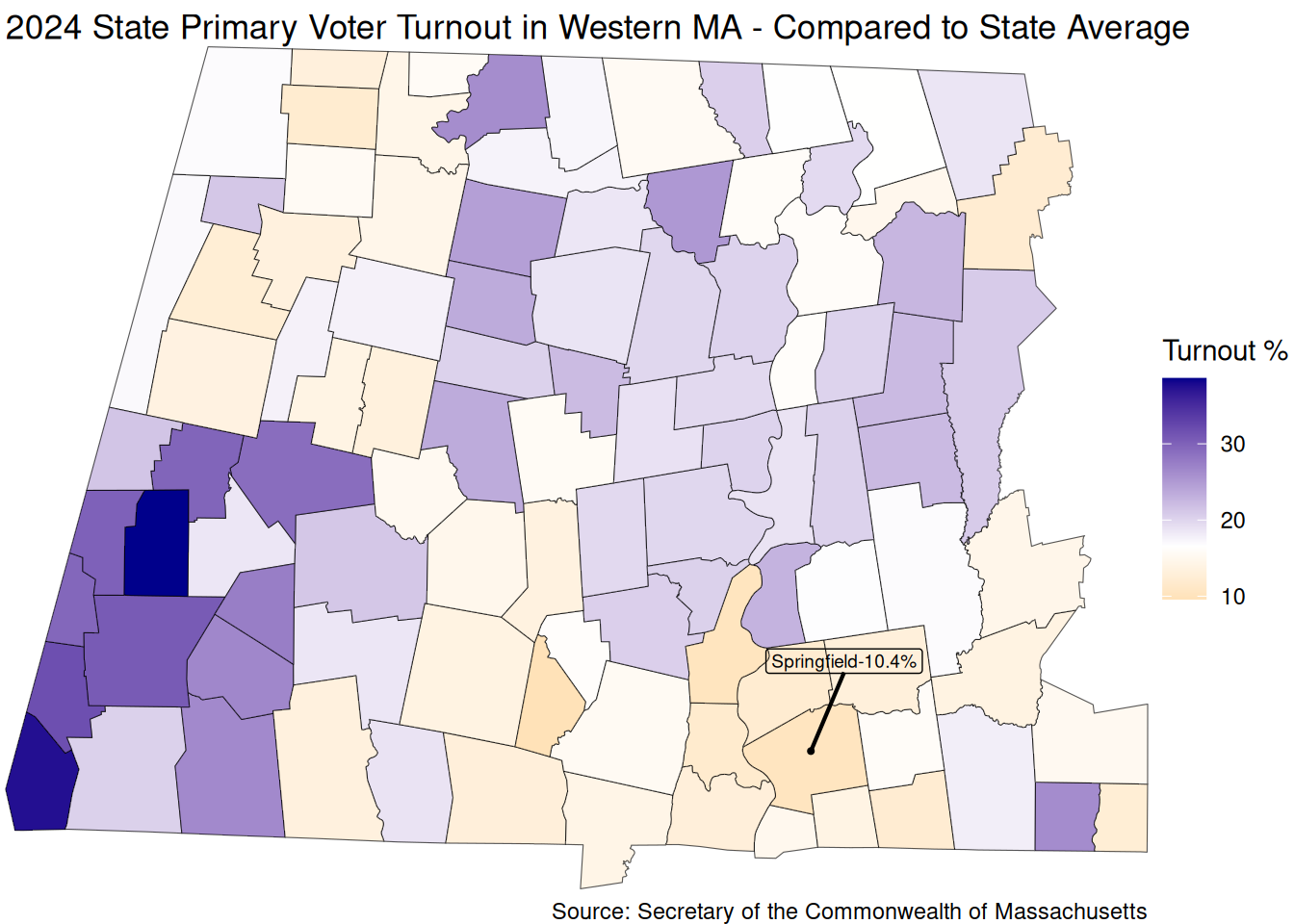
In the 2024 state primary, about 90,000 of Western Massachusetts’ roughly 630,000 registered voters cast a ballot: a turnout of around 16 percent, close to the statewide average. But that regional figure hides wide variation. Towns with small populations, like Mount Washington and Stockbridge, had some of the highest turnout rates in the state, while the region’s most populous city of Springfield had one of the lowest at just 10.4 percent. Only six other Massachusetts municipalities came in near that low, including Holyoke, ten minutes up Interstate 91.
The pattern holds even in elections that usually pull voters out. In the 2024 general election, about three-quarters of Hampden County voters turned out, but fewer than half of Springfield and Holyoke voters did. Springfield had the lowest turnout of any Western Massachusetts community.
“We have a huge mistrust in the system,” said Tracey Carpenter, a member of the League of Women Voters of Massachusetts and the Massachusetts Senior Action Council, speaking specifically about local governance in Springfield. “We’re trying to make it more inclusive,” she said, “and to have a government that really works for us all.”
Economic Barriers
For Tara Parrish, executive director of PVP, low voter turnout in the city is closely connected to Springfield’s economic downturn.
“Here in Springfield we had the Armory, which was a weapons manufacturer,” Parrish said. It closed in the late 1960s, the site now houses Springfield Technical Community College. “That was the economic engine, and once it closed, everything changed here.”
The economy that filled the vacuum runs on service jobs, according to Parrish. The city’s largest employer is its hospital, according to state data, and many of the jobs available pay low wages. The practical result, she argued, is that a lot of Springfield residents are working two of them.
“The jobs that are available here are lower-wage jobs. So a lot of people have a second job, which means that not only do you not have disposable income, you don’t have a lot of time,” Parrish said. “I think there’s a really important connection between the amount of time that people have to sort of lift their heads and look at what’s happening in the city.”
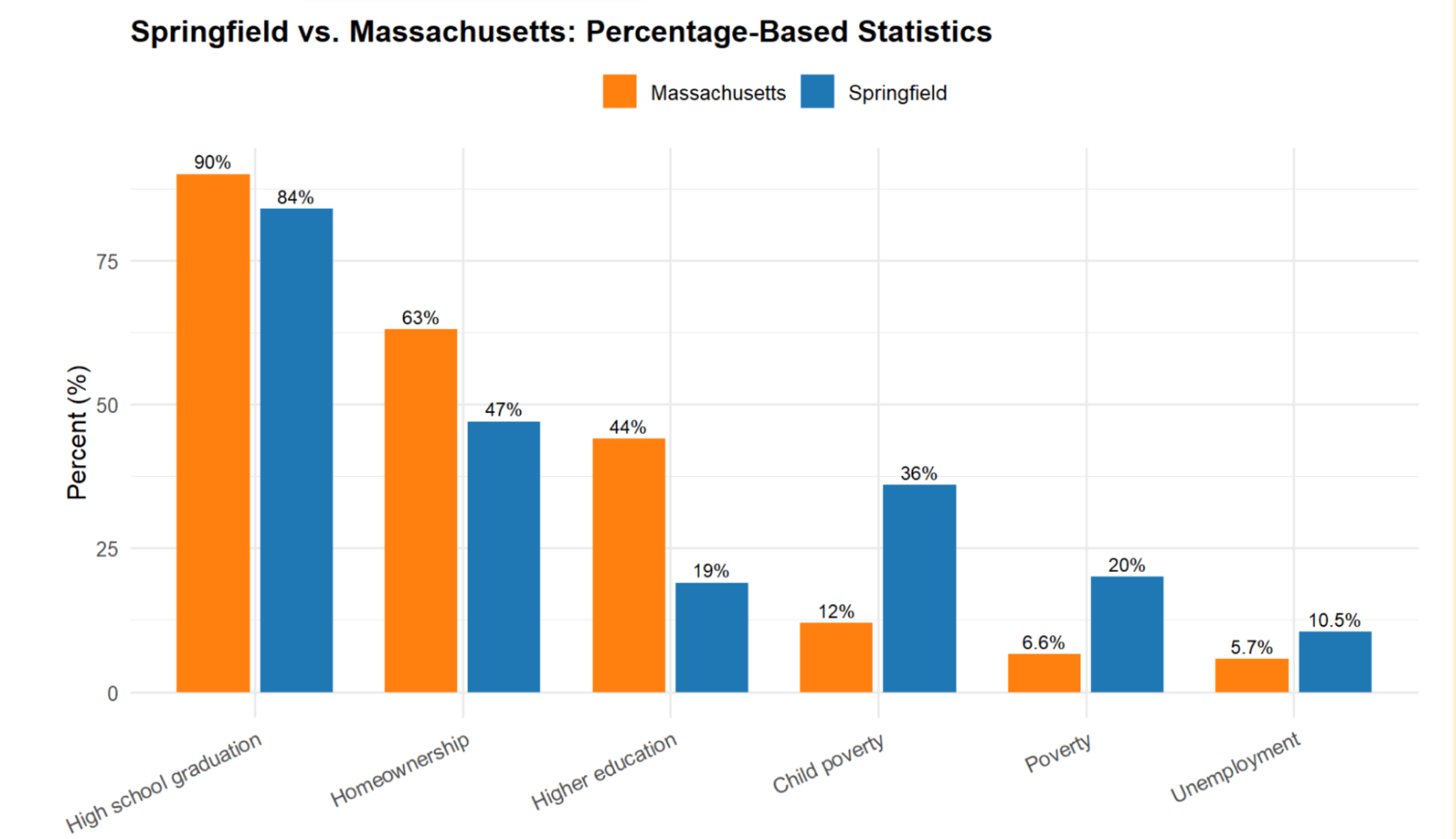
The economic gap between Springfield and the rest of Massachusetts is visible in almost every measure of well-being. Springfield has higher rates of poverty and unemployment, and lower rates of homeownership, graduation, and higher education when compared to the state average.
“Why should I bother?”
“There’s a direct connection between the resources that your child has at their school, the quality of policing and emergency services and whether or not your trash gets picked up in a timely way,” said Parrish.
Springfield experiences severe inequalities with regard to these resources. Neighborhoods in Wards 1-4 have lower rates of homeownership and higher rates of poverty in comparison to Wards 5-8. There’s a direct correlation between low-income neighborhoods and disenfranchised populations, most noticeable in the inactive voter rolls.
Being on the inactive list doesn’t strip someone of the right to vote, but it adds friction: residents have to show ID at the polls, and many don’t know they can still cast a ballot at all. Carpenter described two seniors who went to vote in Springfield, were told they were on the inactive rolls, and simply went home. Staying on the active voter rolls requires answering and submitting responses to the annual city census, sent exclusively by mail – which poses an additional challenge to renters.
Wards 1-4, the city’s lower-income wards, account for over 20,000 inactive voters on the city’s rolls, according to figures obtained from Massachusetts Voter Table by PVP and LWVMA. Wards 5-8 together contain just 145 inactive voters, with no ward topping 50.
The city does not run its own voter education, Parrish added, which leaves nonprofits to fill the gap. “If you go on the city’s website, it’s really easy to get to a point where you’re like, ‘I’m not even going to try to figure this out now,’” she said.
For Parrish, these pieces add up to a rational case for staying home. “Literally some of the most fundamental neighborhood resources and institutional needs that any neighborhood has, aren’t being met,” she said. “I think that all connects with folks feeling like, ‘What’s the use of voting? These people who get elected don’t see us, they don’t fight for us. Nothing is getting better because they are in office. So why should I bother?’”
But for 21-year old lifelong East Springfield resident Nayla Pabon, there’s a different reason. Standing in the shadow of Baystate Medical Center where she works as a medical assistant, she explained, “I don’t really like politics. I think it divides us too much as people and I think it’s very sad.” Most of Pabon’s friends and family vote, but, she said, “it’s just not things I like to get into.” Pabon doesn’t know if she’s registered to vote, and has never voted in any past elections.
Similarly disengaged from the political process, 19-year old Springfield resident Jayden, who did not give his last name for privacy reasons, said “I don’t believe in voting.”
Jayden and Pabon reflect the trend of young voters aged 18 to 29 turning out at lower rates than the rest of the population. PVP identifies this age group as crucial to increasing civic participation.
Youth Outreach: PVP’s Strategies
Mohamed notes that “a lot of people come out of high school and are thrown into the political world and they’re like, ‘I didn’t learn about any of this. What’s actually going on?’”
PVP’s youth leadership team seeks to engage directly with these up-and-coming voters. The youth leadership team operates in Springfield public schools, led by the high school students themselves. Mohamed described an annual program that she led as a former member from 2018 to 2020 where youth leaders set up tables during lunch to run voter registration drives and education sessions for their peers. PVP plans to continue these efforts before the upcoming elections.
This program not only engages youth voters, but also reaches into households and out to other community members who aren’t so inclined to vote. Parrish described it as an inter-generational strategy, where high schoolers who learn about registration deadlines and ballot questions carry that information home. “If young people are educated about the importance of voting,” said Parrish, “they’re gonna bring that into their household as a reinforcing culture of, ’Hey, let’s participate!’”
In addition to working within high schools, PVP also utilizes their youth leadership team to engage with the broader community. PVP distributes voter education materials in six languages and youth members reach out to adults through phonebanking, which Parrish finds particularly effective.
“There is this thing that happens where it’s like, wow, this young person is inviting me to vote, which is infinitely more unusual than some adult inviting me to vote,” Parrish said. “I think we underestimate the value of young people leading in this space. They have the ability to influence not just their peers, but a lot of adults as well.”
Parrish cautioned against reading Springfield’s turnout numbers as a simplistic story about apathetic voters. “I think it’s really important not to look at Western Massachusetts as a monolith,” she said. “Without nuance, it’s easy enough to paint a picture of voter turnout and voter participation in a way that blames the voters themselves.”
With the 2026 midterms coming into view, community-based organizations like PVP and youth leaders like Mohamed hope to push young voters, such as Nayla and Jayden, towards the polls. It’s a question of if grassroots organizing can create motivation among disengaged voters that outpaces the reasons people have stopped showing up.