About
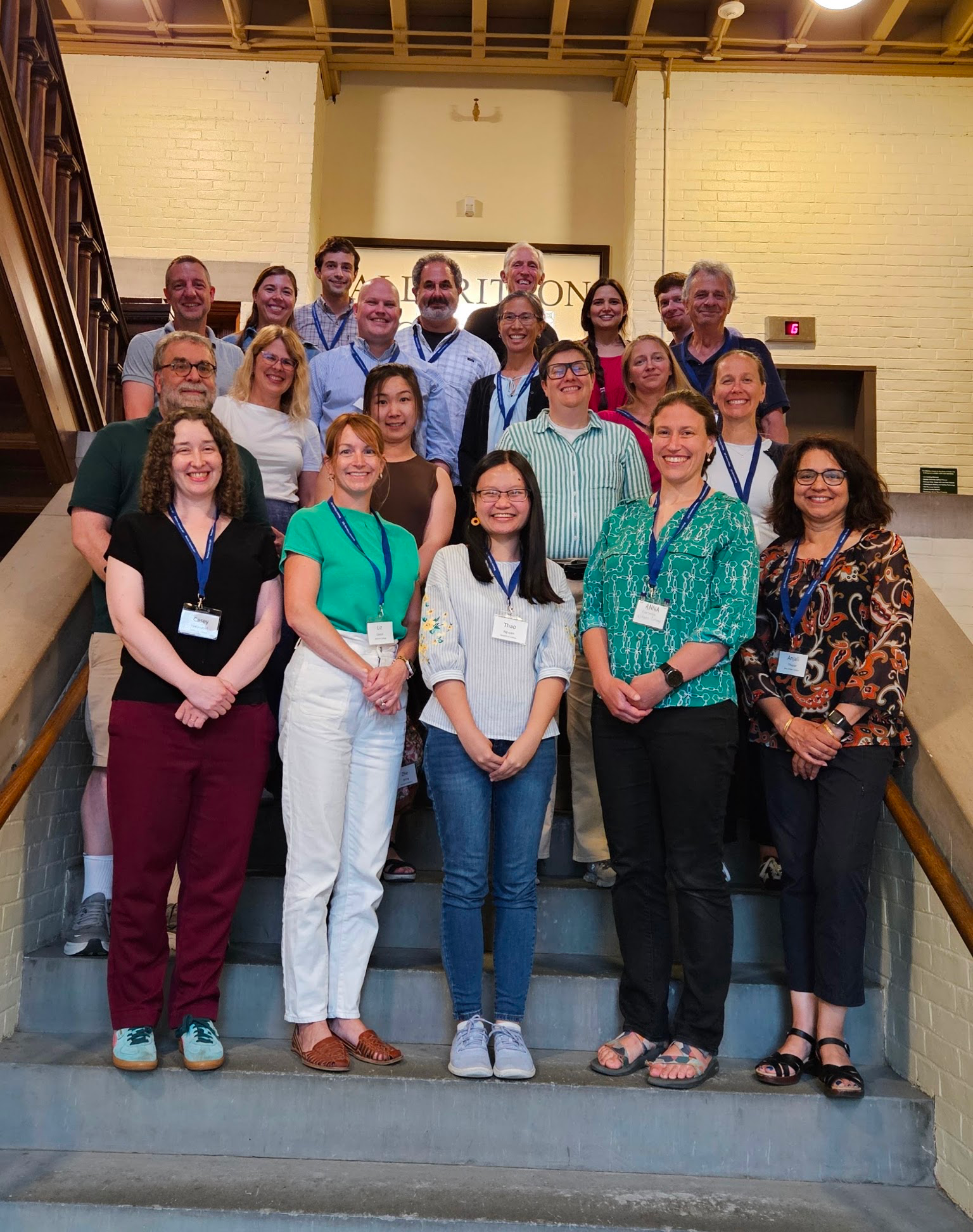
Workshop organizers
- Benjamin Baumer, Professor of Statistical and Data Sciences, Smith College
- Nicholas Horton, Beitzel Professor of Technology and Society (Statistics and Data Science), Amherst College
- Emmanuel Kaparakis, Director, Hazel Quantitative Analysis Center & Centers for Advanced Computing, Wesleyan University
- Sarah Supp, Associate Professor of Data Analytics and Sustainability & Environmental Studies, Denison University
Program committee
- Ming-Wen An, Professor of Mathematics and Statistics on the Elizabeth Stillman Williams Chair, Vassar College
- Sorelle Friedler, Shibulal Family Professor of Computer Science, Haverford College
- Cassandra Pattanayak, Jack and Sandra Polk Guthman ’65 Director, Quantitative Analysis Institute, & Senior Lecturer in Quantitative Reasoning and Mathematics, Wellesley College
- Anna Plantinga, Associate Professor of Statistics, Williams College
- Lynne Steuerle Schofield, Professor of Statistics and Chair of Department of Mathematics and Statistics, Swarthmore College
- Marc Schulz, Professor of Psychology on the Sue Kardas PhD 1971 Chair and Director of Data Science, Bryn Mawr College
Invited plenary speaker
- Alex Reinhart, Associate Teaching Professor of Statistics & Data Science, Carnegie Mellon University.
Alex is the author of recent research papers that compare the style and structure of student-, expert-, and LLM-written statistical reports, revealing unexpected biases in the writing style of LLMs, and considering the implications for students still learning to write like experts.
Title: The role of AI in statistics and data science education
Abstract: It is easy to give in to angst about generative AI and its effects on students and teaching, or to tech marketing that AI will solve all our problems. But before we make dramatic changes, we should consider what we know about pedagogy, how students learn to become experts, and what kinds of training are most effective. We can then design our curricula based on the education research. If we treat AI use as a question for education research to answer, not just as a new classroom tool, we have the opportunity to advance data science education. It will be a challenge, because early research shows many pitfalls for AI use in the classroom, but it is a challenge that liberal arts colleges – with smaller class sizes and their existing focus on innovative teaching – may be well-placed to face head-on.
Workshop liaison
- Emmanuel Kaparakis
Director, Hazel Quantitative Analysis Center & Centers for Advanced Computing
Wesleyan University
222 Church Street
Middletown, CT 06459
860-685-3795
mkaparakis@wesleyan.edu